Heidi Hammel Quotes
Because exploration is not science driven, you've got to ask what is it driven by? And it's driven by politics.


A week is a long time in politics He also appears to have made this statement at another occasion with a week being the time.


One classic example is the scientist who is testifying before a Congressional Committee. Typically if there is a political issue, the politician of each viewpoint will find a scientists who supports their view. In a huge country, they can always find on or two to support any idea regardless of its validity. In the world of science, the scientist who has been doing experiments in a field for years and has published articles in peer-reviewed journals, teaches other scientists who do outstanding work, and have won prizes or accolades from his/her peers is given much more credibility than the scientist who has none of these accomplishments and just may have a different point of view and claim that the first scientist is in error UNLESS the critical scientist can show mathematical or other scientific proof that the first is wrong. Often in politics, the lesser critical scientist offers questions which the leading scientist cannot answer bit in science that proves nothing. There is ALWAYS much more a scientists does NOT know about an area than he does know. See {623513}.


Critics were divided as to whether this illustrated that Graham was very naïve or very hypocritical. Graham had given Nixon a platform but he attended many Nixon events and was thought of as close to the President. When Watergate finally broke out in the open, Graham, had a major realignment of his view of politicians and has never gotten as close to any politician or appeared to favor a politician since.


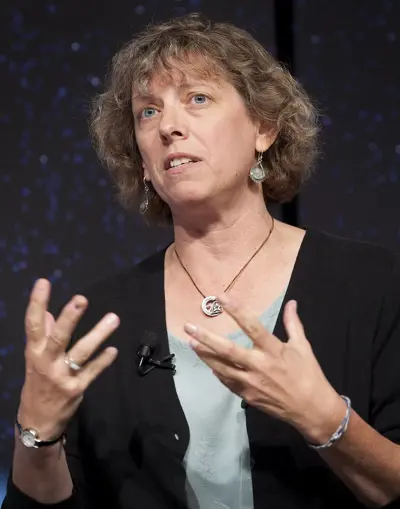
Heidi B. Hammel is a planetary astronomer who has extensively studied Neptune and Uranus. She was part of the team imaging Neptune from Voyager 2 in 1989. She led the team using the Hubble Space Telescope to view Shoemaker-Levy 9's impact with Jupiter in 1994. She has used the Hubble Space Telescope and the Keck Telescope to study Uranus and Neptune, discovering new information about dark spots, planetary storms and Uranus' rings. In 2002, she was selected as an interdisciplinary scientist for the James Webb Space Telescope.
