Jessica Mathews Quotes
Bargaining chips that you never get to spend are not worth anything
Jessica Mathews, Director, Office of Global Issues at the National Security Council President of the Carnegie Endowment for International Peace, Interview, PBS The Charlie Rose Show, May 2, 2014
Sourced by: Eigen's Political and Historical Quotations


At the time the United States was leading a very effective set of economic sanctions against Iran for the express purpose of pressuring them to abandon their nuclear development program that could also be used for nuclear weapons development.


Boehner’s Republicans controlled the House of Representatives. However the Democrats controlled the Senate and Obama, the president, was a Democrat. So while Boehner could block any legislation, he could not pass legislation that the Republicans wanted. So the speaker resorted to the tactic of holding for ransom import legislation unless the President and the Democrats would pass legislation that the majority of the public and the Democrats were against. In this case it was the debt ceiling limit. The United States spends money authorized by Congress and then has to pay the bills. When the country is growing, the government has to borrow money in order to meet its obligations and pay bills. Congress must authorize the increase in the debt limit. Boehner held the debt limit hostage until Obama would agree to spending cuts that were unpopular with the majority. A problem for the Republicans with this strategy however was that the government would not have enough money to pay the regular bills and the government would have to slow down. This was considered a most unpatriotic thing to do and one would put the United States full faith and credit at risk. Republicans justified it on the grounds that spending money as the government was doing was worse and therefore it requires extreme measures. This was not the only occasion where a political party put its ideology ahead of the welfare if the nation as a whole. But in those few past occasions the party doing this was not overt about it, and could never be accused of blackmailing. What made this quotation remarkable was that it was the first time that the politician was very explicit about the blackmail strategy. President Obama actually caved in a bit and compromised and reduced spending so the debt ceiling was raised. Earlier, President Clinton had the same tactic tried on him but he let the Government shut down, and after a few days, The political heat on the Republicans were so great that they had to raise the debt ceiling and reopen the government.

The immediate crisis had been averted and no more nuclear missiles would enter Cuba. But we had no leverage to get the few that were already there removed and it would be politically very difficult for the Kennedy administration to get the public to accept ANY nuclear missiles in Cuba. Hence, Stevenson’s statement. See {634554}. Neither side had great intercontinental ballistic missile capability at the time, and we had placed a large battery of missiles in Turkey very close to the Russian border. This gave the U. S. a major military advantage. We could deliver many more nuclear warheads to Russia than they could to the United States. The Russians with this proposal hoped to even the capability. The military advisers and the security and State Department advisors all thought that the U. S. should not give up its nuclear superiority. However, we had no international legal basis for denying the Cubans the right to locate any weapons on their soil, so to prevent the Communists from having nuclear missiles in Cuba we would have to use force which could easily escalate into a nuclear war. Kennedy and McCone both thought that since we had intercontinental ballistic missiles in production and coming on line and would not need the Turkey Missiles to strike all over Russia. So giving up our missile advantage for a short time would not expose us to any undue risk. The other advisors worried that the production of the ICBMs could be delayed—weapons systems were (and are) notoriously longer in production than estimated or planned. They also thought that the morale of the military and civilian population would suffer when they learned that we had given away our military advantage. There was a macho element in their thinking in that we would be giving in to intimidation and look like we were afraid to fight. Last, the political advisors thought that the right wing hawks would pillory the administration for its cowardice in allowing itself to be intimidated by the Russians. Their doctrine was that when faced with force, the Communists will always back down. In the final deal we agreed to remove our missiles from Turkey in 6 months and this would be done in complete secrecy and the Russians would keep the deal secret. That way, Kennedy got 6 more months of production which turned out to have been enough. The public would never know till years later and the Conservatives would not be able to publicly castigate Kennedy. Meanwhile, the conservatives would continue to believe that the Russians backed down in the face of force—the naval blockade as this was ‘proved’ their doctrine when the Russians had not backed down at all. The strategy and tactics of the Kennedy administration are still analyzed and argued about today with many Americans just realizing that we did not intimidate the Russians with force or the threat of force to remove their Cuban missiles.

Rome & the Roman Catholic Church Islam, led by the Ottoman Turks, were in a constant state of tension against the Christian World of Europe. However there had been a huge schism in Christianity where the Christian Roman Empire was split in two—a Western (Latin) Empire led by the Roman Catholic Church in Rome, and the Eastern (Greek) Roman Empire led by the Orthodox Church headquartered in Constantinople (Byzantium). The two churches were not only in a theological conflict but violence broke out and the armies of the two religious empires attacked each other now and then. This was a great advantage to the Muslims who were essentially unified under the Ottoman Turkish Sultan. Manuel knew that the reunification of Christianity was about the worst thing that could happen from the geopolitical view of the Ottomans and they always placed a high priority on doing whatever they could to magnify the stress between the two Christian empires. Manual and the Orthodox hierarchy were absolutely opposed to union as the schism had been precipitated by them to begin with. However, Manuel knew that the hatred of the East and the Orthodox Church was so great amongst the Latins that even if some of the Roman Catholic leadership might be interested in healing the schism and having a “unity in Christ”, the kings and nobles of the Western European nations would never accept unity and would scuttle the negotiations. This quotation is an excellent example of the kind of complex, foreign policy and political intriguing that caused our language to have an adjective—byzantine—which is in common use today.

FDR was not always pro-British as many conservative opponents claimed. He was actually quite suspicious of the British though his concerns evaporated with the crisis of the rise of Hitler and WWII.

Some people believe that the United States pressured Pakistan to enable America to support the Mujahideen in their effort to fight the Russian occupation of Afghanistan. Actually the President (and virtual dictator) of Pakistan wanted aid from America and was offering bases. America did not want bases but did want a platform for arming and training the Mujahideen, Pakistan allowed us to use Pakistan as a platform. We increased our foreign aid to Pakistan by 500 percent. There was no arm twisting.

The Secretary of State had obtained an agreement of Israel and the Palestinians to open Peace Talks. The press immediately wanted to know who was saying what to whom and what positions the parties had. However, this was a classic example where transparency would make successful negotiations impossible—it would end the negotiations before the parties could even discuss possible alternatives.


There have been times in democracies where a foreign ministry (State Department) is isolated from the elected politicians and implements a foreign policy that is at odds with the wishes of the elected officials and the majority of the nation. A good American example of this was in 1948 where America had to decide whether to support the creation of the State of Israel in the United Nations and through diplomatic recognition. The professional diplomats in the State Department had developed very close relations with Arab States, and many State Department employees were anti-Semitic. In addition, they thought the most important thing for America was not to risk the Arab oil supply. Meanwhile, the people, Congress, and President Truman were on the other side and Truman had to finally order The Secretary of State to stop his professional diplomats from pursuing their own foreign policy preferences. Even then some did not.

By the standards of the rest of the world the North Korean policies and actions were at the time irrational and inconsistent and explained in a manner which defied any norms that any other nation’s leaders could understand and explain.


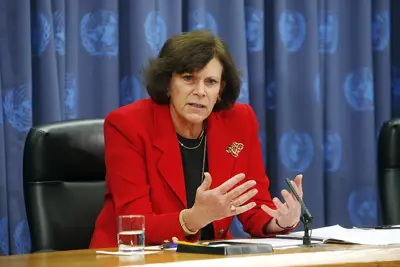
Jessica Tuchman Mathews is an American peace activist. She was President of the Carnegie Endowment for International Peace, a foreign policy think tank in Washington, D.C., from 1997 to 2015. She has also held jobs in the Executive and Legislative branches of government, management and research in nonprofits, and journalism.
