John Quincy Adams Quotes
At the [U. S.] House [of Representatives], Stephen Douglas, of Illinois, the author of the majority report from the Committee of Elections, had taken the floor last evening, and now raved out his hour in abusive invective upon the members who had pointed out its slanders, and upon the Whig party. His face was convulsed, his gesticulations frantic, and he lashed himself into such a heat that if his body had been made of combustible matter it would have burnt out. In the midst of his roaring, to save himself from choking, he stripped off and cast away his cravat, unbuttoned his waistcoat, and had the air and aspect of a half-naked pugilist. And this man comes from a judicial bench, and passes for an eloquent orator!
John Quincy Adams, 1767-1848, 6th President of the United States (Independent, MA), Diary, February 14, 1844
Sourced by: Eigen's Political and Historical Quotations


One of their friends was then Judge Stephen Douglas who advocated equality for Mormons and appointed Mormons to various posts. Mormon support helped the Democrat’s Thomas L. Ford win the next gubernatorial race over his Whig opponent who was virulently anti-Mormon.


Mrs. Roosevelt, on her own, would criticize the ethics of certain campaign techniques and would criticize them. However she doesn’t say publicly which party she was chastising—her Democrats or the Republicans. And she starts by honestly stating that both parties do this and she tells the readers that it is the campaign headquarters who go to these extremes. Her technique was very effective in that the political operatives who released the sleazy material knew who they were, and realized that if they kept doing it, people would find out that they were the villains. Very often they just stopped, and that was what Mrs. Roosevelt wanted. She wrote this two months before the Presidential elections without every checking with the campaign staff and leaders who read it in the newspapers every day like everyone else. Needless to say that they were not happy, but the President was fine with it and she has had more independence of action and writing than any First Lady in history. She even disagreed with the President slightly sometimes, but usually she was very supportive of FDR and the New Deal. It is hard for us years after to realize that she had a newspaper column published every day in papers throughout the country, she had a regular radio show. Her views reached more Americans every day than the President’s and the campaign staff’s. Her husband was elected to 4 terms—more than any other American President, and yet until Hillary Clinton, no first lady every had gotten overtly involved with public campaigning and political communications, and Mrs. Clinton was nowhere near as active or independent as Mrs. Roosevelt.


impeachment of President Andrew Johnson Garfield was then a Congressman

He was considered Massachusetts’ greatest Colonial orator.


Logan was a chief of the Mingo tribe, an offshoot of the Iroquois nation. He was a great orator.


Trump, in the 2016, Presidential Campaign viciously attacked not only his Republican opponents for the Republican Nomination, but almost every other Republican leader, the Republican National Committee members and the “Establishment Republicans.” He not only called them names, and ridiculed them and their families, but he lied extensively about each of his opponents and the Republican National Committee. Trump also alienated women, Hispanics, Muslims across the country. The Republican party was fractured and there were great resentments. Many blamed Tump for the Party cleavage. However, what is interesting about this quotation is that Roy admits that there were huge cleavages within the party as the Result of the Tea Party Republicans intransigence before Trump entered the campaign. He just took advantage of it and used it to his advantage. Roy at this time saw the Republican splits and resentments as too deep to be able to bring the party together shortly. The split persevered.


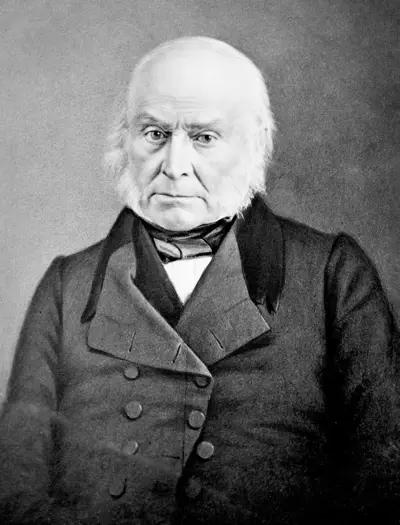
John Quincy Adams was an American statesman, diplomat, lawyer, and diarist who served as the sixth president of the United States, from 1825 to 1829. He previously served as the eighth United States Secretary of State from 1817 to 1825. During his long diplomatic and political career, Adams also served as an ambassador, and as a member of the United States Senate and House of Representatives representing Massachusetts. He was the eldest son of John Adams, who served as the second U.S. president from 1797 to 1801, and First Lady Abigail Adams. Initially a Federalist like his father, he won election to the presidency as a member of the Democratic-Republican Party, and in the mid-1830s became affiliated with the Whig Party.
