Antony Beevor Quotes
At the beginning of June 1944, the war was reaching a climax. German troops had been brutalised by the savagery of the ongoing fighting in Russia, where the Red Army was secretly preparing its vast encirclement of the Germans' Army Group Centre.
Beevor, Antony. D-Day: The Battle for Normandy. Viking, 2009, p. 1.

The Russians had lost over 20 million of its people to German WWII hostilities. They wanted a vengeance and were willing to take the casualties that came with the invasion of Berlin and many other key cities that were heavily defended. Eisenhower and Churchill realized that this would give the Russians a very dominant military occupation of Eastern Europe and Eastern Germany. However, they did not want to take the huge casualties of all these battles. Politically, Churchill and American leaders had to explain to their right wings why Russia was involved as an equal partner in making occupation decisions about Germany.


The general was replacing George S. Patton as commander of the Third Army. Patton had opposed the deNazification policy of the allies and caused a great deal of public relations difficulty for the army command and the administration, as reporters would frequently print his views. Truscott was one of Patton’s loyal assistants. The minute he took over, the press wanted to find out if his views were the same as his former boss regarding the Nazis. They were quite different. Reporters had no story.


One of the predictions of the oncoming war with Germany.


A little over a decade later the struggle began.


FDR was right about Russia being a major factor in stopping Hitler, but partially wrong about the danger of Russia. The Soviets never did dominate Europe although the tried, but they did dominate Eastern Europe.

Note that he assumes that not only will there be another World War, but he assumes that we will be on opposite sides.


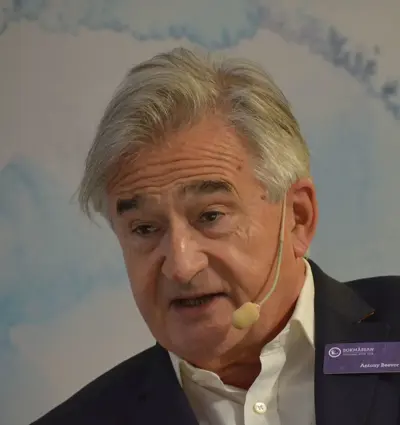
Sir Antony James Beevor, FRSL is a British military historian. He has published several popular historical works on the Second World War and other wars during the 20th century.
