Walther Funk Quotes
At that time I believed in the Führer principle because to me it meant that the best one should be the leader. If the leader is good and responsible, then the government is good.
Walther Funk, 1890–1960, Minister for Economic Affairs in Nazi Germany, Convicted War Criminal, Interview with Leon Goldensohn, April 14, 1946, from "The Nuremberg Interviews
Sourced by: Eigen's Political and Historical Quotations

This quotation is important because there are some who believed that the professional German Soldiers did not respect Hitler and his murderous policies. This quotation shows that at least publicly Donitz had no problem extolling Hitler above all others. After the war Donitz was found guilty of Unrestricted Submarine Warfare and using thousands of slave laborers in his shipyards. He was sentenced to 10 years, one of the lightest sentences if the German War Crimes Trials.

Helms was then a young agent of the Office of Strategic Services (OSS) in Berlin.


by aiding the nationalist / Fascists in the Spanish Civil War

Many of the early democracies had failed when in crises the citizens turned to a strong leader who soon became a monarch. The early democracies did not have the mature democratic institutions that we now know are so important for the success of a democracy.
He served a 20 year sentence. Unlike many of the other Nazis, upon reflection of his experience, he came to realize the wisdom of Lord Acton’s observation about power. See {292904}.


While England was under attack by the Germans in World War II, Congress was debating Roosevelt's proposal for lend-lease. The president had set the passage of this legislation as his main priority, and a critical meeting between Churchill and Roosevelt was deferred until passage was obtained. Roosevelt dispatched Hopkins to London. Urging a prompt meeting, Hopkins cabled:


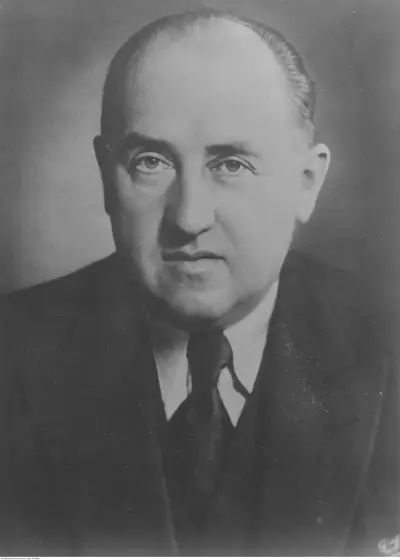
Walther Funk was a German economist and Nazi official who served as Reich Minister for Economic Affairs from 1938 to 1945 and was tried and convicted as a major war criminal by the International Military Tribunal at Nuremberg. Sentenced to life in prison, he remained incarcerated until he was released on health grounds in 1957. He died three years later.
