Peter Bergen Quotes
As we have learned to our cost in recent years, much “secret information” is simply wrong, while information that is public … is too often discounted.
Peter Bergen, Political Scientist, “Reading Al Qaeda: The Jihadists Export Their Rage to Book Pages and Web Pages,” The Washington Post, September 11, 2005
Sourced by: Eigen's Political and Historical Quotations

Arguably, in the intelligence world, most of the classified documents are not truthful because there are many different work products that are designed to obtain all points of view. There have been major areas were NONE of the documents on a subject were true as they were all based on faulty assumptions or ignoring critical information. None of the classified intelligence documents even hinted at the breakup of the Soviet Union for example. By number, most of the documents in the FBI secret files are raw intelligence reports and are full of unverified opinion—including biased and self-serving statements.


The argument here is that secret intelligence, comes from sources and people whose views and claims are not subject to the test of public scrutiny representing a narrow information sample. Publicly available information, while it does not include secrets that the enemy wants to keep secret, does represent vetted and processed information with challenges and contradictions also publicly available. Proponents argue that it is more reliable. Secret intelligence has produced some of America’s worst debacles. An example is the Bay of Pigs. Secret intelligence assured Presidents Eisenhower and Kennedy that the majority of Cuban people was hostile to the Fidel Castro government. If freedom fighters would land in Cuba, the vast majority of Cubans would join them. When the invaders landed, most Cubans were so outraged that their country was being invaded that there was massive public support for Castro’s troops who quickly captured the invaders who were waiting for the popular uprising.

The George W. Bush Administration had initiated a secret wiretapping program without informing the Congressional Intelligence Committees as required by the statute or requesting a change in the law from the Judiciary Committee. New York Times, however, had discovered the program and published its existence. This was the way that Congress found out about the program that seemed to violate the law. The Attorney General however was critical of New York Times, and expressed concern that the press had published secret material.

Agree resigned from the CIA in protest to its political position.


Wikileaks had just released 400,000 classified American documents relating to the Iraq War. Many accused him and Wikileaks of endangering the lives of not only soldiers, but Iraq civilians who might be identified as cooperating with the coalition forces by the released documents. The heart of the problem is that governments tend to use classification to hide embarrassing facts or policies that might be controversial as well as to protect legitimate national security secrets and sources and methods of information. The majority of the 400,000 leaked documents, when examined, were clearly not protecting any legitimate people or secrets but just staved off criticism or embarrassment; in many cases, there was no value to the contents and the maw of the censorship and classification process was applied indiscriminately to many documents. A much better argument than Assange made, can be gleaned from the vast number of WWII documents that America, England, France, Russia and others still keep secret, when the people who might have been protected have already died and the methods are long since obsolete.

There are many things about our enemies which they know that we know which are still kept classified because it would be embarrassing for the government, a previous administration or to an agency to reveal it. There are some documents that are classified even thought the enemy knows we have the information because if the document were released the enemy might find out the sources of the information which they do not know. However often they know that too. Potential embarrassment and scandal are the main reasons for keepingthings that the enemy knoews we know secret.


Gelb was referring to the Cuban Missile Crisis in 1963. The Russians had installed ICBMs in Cuba and more were coming by sea. WWIII could have started with a misstep by the United States or the Soviet Union. President rejected the advice of some hawks to attack and/or invade Cuba and be ready to attack Russia with nuclear weapons. Instead, he authorized a naval blockade of all ships and planes going in or out of Cuba. There were some negotiations with the Russians, and in a few days, the Russians dismantled and removed the missiles from Cuba and we lifted the naval blockade. The perception was that Kennedy faced down the Russians who capitulated when faced with firmness and force. Actually, Kennedy gave the Russians much more. He agreed to remove the American ICBM Jupiter missiles from Turkey. But if that were known in America, the right wing would criticize Kennedy mercilessly for appeasing and capitulation to the Russians. The Russians agreed to keep it secret, and the Executive Branch classified it top secret and kept the entire deal from the public. 50 years later, Gelb, one of the few people in the government then who knew the entire deal, wrote this article pointing out that there was a serious danger to what we did to make that deal a secret. Many hawks took the Cuban Missile Crisis as proof that the Russians would back down when faced with a fait accompli and would not retaliate. They then formulated much American foreign and military policy on the assumption that the Russians will capitulate when faced with our tough unilateral terms. The reality of course was just the opposite. The Russians would only agree to a peaceful solution if we withdrew all our missiles that were threatening them and end the naval blockade of Cuba. The Russians got us to remove our missiles for the relatively cheap price of removing from Cuba just a few missiles that they had just installed. Kennedy looked like the strong hero who stood up to the Russians while in reality, he and our military and state department lost a diplomatic contest of sorts. Kennedy apologists argue that because America had developed longer range ICBMs, the Jupiter Missiles in Turkey were not that important, and Kennedy really gave up nothing of value. The Kennedy team clearly didn’t want to argue that point in a public debate, and chose secrecy where the enemy clearly knew the whole story, but our allies, our civilians, our politicians and even most of our military were in the dark.

He was referring to the massive surveillance NSA program whereby all telephone calls and most digital communications for every American was secretly tapped and stored in an NSA data base. The Senators of the Intelligence Oversight Committee received information in Classified executive sessions but they were not allowed to disclose anything that they learned in the briefings—even something as huge and probably unconstitutional as this program. Moreover, even when officials of the Intelligence Services lied under oath (see {634917}) in open session, the Senators could not disclose this fact.

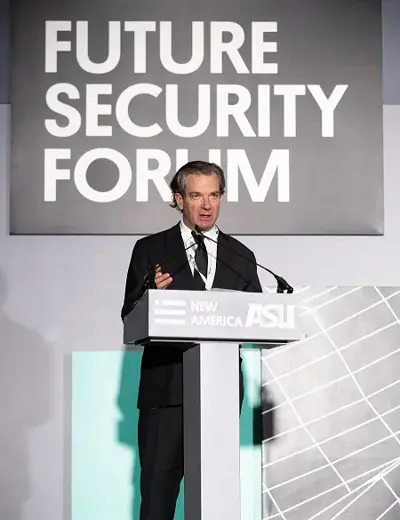
Peter Bergen is an American journalist, author, and producer who serves as CNN's national security analyst, New America's vice president, and as a professor of practice at Arizona State University. He produced the first television interview with Osama bin Laden in 1997. The interview, which aired on CNN, was the first time that bin Laden was interviewed by Western media.
