George F. Kennan Quotes
As to Korea, there is no longer any real hope of a genuinely peaceful and free democratic development in that country. Its political life in the coming period is bound to be dominated by political immaturity and violence. Where such conditions prevail, the communists are in their element. Therefore, we cannot count on native Korean forces to help us hold the line against Soviet expansion
This intelligence analysis turned out to predict exactly what happened. Less than 3 years after this report, the Communists overran South Korea and the Korean War began. See {584008} for another remarkable foreign policy prediction.
George F. Kennan, 1904-2005, Historian & U.S. Ambassador to Russia and Yugoslavia, Secret State Department Intelligence Report, November 6, 1947, Foreign Relations of the United States: 1947
Sourced by: Eigen's Political and Historical Quotations

This was one of the most accurate foreign policy assessments ever made. The next year the first Arab-Israeli war began when the state of Israel came into being. See {624566} for another accurate prediction.


The Korean War armistice left a vulnerable border between North and South Korea and approximately 40,000 American troops were necessary for decades thereafter to protect the border.

There were many who thought that the Russians would view the Mutual Security Act as aggressive and they might respond with some kind of aggressive retaliation and this could lead to war. Others felt that containment would reduce the likelihood of war.

Trieste was occupied by the British and Americans theoretically, but Tito’s Yugoslavian troops had done most of the WWII fighting and dying in the area and wanted control for the Russian Allies of which Tito was then one. There were frequent armed standoff’s of Anglo Americans and Yugoslav troops that could easily have evolved to full scale fighting. Nine months later, Tito broke with Stalin. An interesting historical fact is that Richard M. Nixon was one of the Congressional Delegation then visiting Trieste.

After the Second World War Japanese industry had mostly not yet been rebuilt from the destruction of the allied bombing. The automobile industry, which before the war had aspirations of worldwide competition had been reduced to one company making less than 1000 cars a year and not many more trucks. However, when the Korean War broke out, there was a need for many military vehicles to support the allied war effort. Japan being so close and having very low labor rates had the opportunity to supply many of the needed vehicles. This allowed Nissan, Toyota and Datsun to get on their industrial feet, and from there to become world leaders. Hence, for Japan, the war was a gift from the Gods.
Kennan was one of the few people who saw the possibility of Soviet rule of Eastern Europe crumbling as it did almost 50 years later. Most Americans thought that the Soviet Union was so militarily entrenched that they would never be ousted short of war.

After the breakup of the Soviet Union, NATO expanded to include some fo the former Soviet Nations thus moving NATO territiry to the East--closer to Russia, whose leaders percieved that the expansion was hostile and dangerous for the indpendence of Russia. What made the situation more complex is that the American Secretary of State, when the Soviet Union was very powerful, had made an agreement with the Soviets that in return for Russian aquiessance of NATO being extended to East Germany, NATO would not expand further West. But after the collapse of the Soviet Union, Russia was quite weak and NATO expanded east despite the earleir comittment. The US and th eother NATO counties took the pozition the previous comitmnts were not binidng as they were never formally signed. The Russians then decided to take a hard line position and flaunt and use military force to which would stop the Western expansion closer to the Russian border.
The veracity depends on how one defines a democracy. Serbia attacked Croatia and Bosnia—all fledgling democracies. Argentina, claiming to be a democracy, attacked England by invading the Falkland Islands. Hitler was elected in Germany in a free and fair election, and once they started their aggressive war Germany became a Fascist Dictatorship. What appears to be the case is that stable industrial democracies never make war on each other.
Like many in the 1920s, Dewar saw the Communist Soviet Union as the biggest potential risk to peace. However, although the Russian leaders constantly castigated the West, they did not have a large military, and were for the most part highly anti-war as they saw war as the product of Capitalistic competition and the tool of the aristocracy. They had little military equipment and almost no training or officer corps with which to build any Army. Germany in contrast had the skill, experience, officers, a history of aggression, and huge resentment over what they considered their humiliating WWI defeat and peace terms. They would start WWII, not Russia.
The first has already occurred; the second is still an open question.

This statement became known as "The Truman Doctrine." Truman asked for $400 million to help Greece and Turkey fight stave off armed Communist minorities destabilizing their governments.


She and her husband, like many of the "America Firsters", believed that Hitler should be allowed to overrun Europe and Russia.


The issue of unilateral or multilateral foreign policy efforts faced America after WWII.

Ironically, at the time she wrote this column, Mrs. Roosevelt was being accused of being a communist by some Southerners who associated her strong views against racism and segregation. Some in the North thought she was a communist because of her active role in the New Deal, Yet here she was, willing to use military force to prevent Soviet expansion.

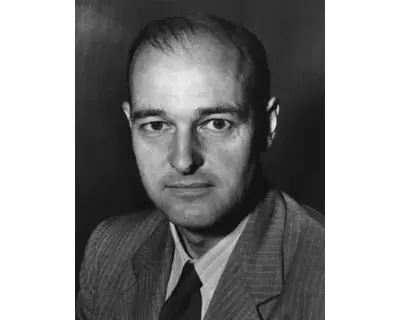
- Born: February 16, 1904
- Died: March 17, 2005
- Nationality: American
- Profession: The Sources Soviet Conduct
George Frost Kennan was an American diplomat and historian. He was best known as an advocate of a policy of containment of Soviet expansion during the Cold War. He lectured widely and wrote scholarly histories of the relations between the USSR and the United States. He was also one of the group of foreign policy elders known as "The Wise Men".
