Paul Krugman Quotes
As soon as the word “guns” enters any political discussion, all rationality goes out the window.
Paul Krugman, Economist & Political Columnist, Nobel Laureate in Economics, CNN Global Public Square, February 10, 2013
Sourced by: Eigen's Political and Historical Quotations


The Southern Rebels who insisted on their right to have guns during Reconstruction, viciously denied that same right to the newly freed slaves. Sickles tried to remedy this, but the KKK and other terrorists intimidated most of the Blacks into not using the right that they had. Later, they would do that with the right to vote.


See Wayne LaPierre {608707} for an example of the NRA position.

10 years later the Supreme Court ruled that such a prohibition would be unconstitutional.


The 2nd Amendment to the Constitution has, according to all Supreme Court decisions, never given the right to bear arms to individual citizens—only to the state militia. Nonetheless, most polls show Americans believe the 2nd Amendment applies to individual citizens:

Gunsmiths were few in early America and a skilled gunsmith could only make about 3 per month. As a result guns in early America were a luxury and few Americans orned them. This is contrary to the myth that the early Americans were all gun owners and sharpshooters.

This was the critical Supreme Court decision which finally decided the long debated issue or whether the right to bear arms was an individual right or a collective militia right. Scalia’s majority opinion ruled it an individual right, but it allowed for exceptions where there might be unusual individual risk. It also upheld the right of the government to control where guns are carried and to regulate the commercial sale of firearms which some of the pro gun extremists had insisted the government had no right of regulaltion.


Like many other ideologues, the Senator was a better politician than he was a historian. He had a tendency to not be very accurate in his facts. In this particular gaff, which was castigated by critics, he was wrong about both facts he gave. First, not only was it not the case that there were few gun crimes “back then”. See {640086} and {640085} . Second his implication that everyone carried guns, and the guns were responsible for the “low” gun crime rate, was also false. Gun crime was so prevalent that most towns and cities in the West had gun control ordinances prohibiting carrying guns in the city limits. The famous Gunfight at the OK Corral which the Senator cited was in Tombstone, AZ in 1881. At that time, it was illegal to carry a gun in Tombstone. See {640063} for the gun control ordinance. As a matter of fact, the OK Corral gunfight was fought because Sheriff Wyatt Earp was disarming some cowboys who brought their guns to town. Glen Kessler, The Washington Post fact checker gave this quotation “3 Pinocchios”.


This quotation is often provided by historians studying the gun culture of America. Even conservatives like Ames did not see a gun or an armed citizenry as important to America’s survival or well being. Contrary to popular belief, even the State Militias’ whose rights to bear arms was written into the Second Amendment did not bother to do so. In 1803 only three state militias had rifle companies. Firearms of the time were expensive, difficult to maintain, and hard to use. Unless one needed them for defense, it was too much of a bother. Even in the aftermath of the War of 1812 only 30% of Massachusetts adult men owned guns; by 1839, the rate was below 10%. It was on the frontier where guns were popular and necessary. See {613080}.
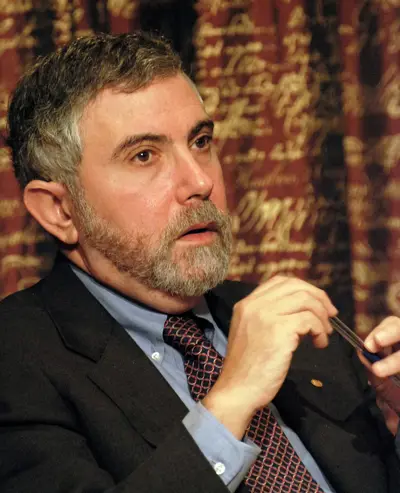
Paul Robin Krugman is an American economist who is the Distinguished Professor of Economics at the Graduate Center of the City University of New York, and a columnist for The New York Times. In 2008, Krugman was awarded the Nobel Memorial Prize in Economic Sciences for his contributions to New Trade Theory and New Economic Geography. The Prize Committee cited Krugman's work explaining the patterns of international trade and the geographic distribution of economic activity, by examining the effects of economies of scale and of consumer preferences for diverse goods and services.
