Thomas Aquinas Quotes
As regards the individual nature, woman is defective and misbegotten, for the active power of the male seed tends to the production of a perfect likeness in the masculine sex; while the production of a woman comes from defect in the active power.
Thomas Aquinas, ~1225-1274, Catholic Saint & Italian Scholastic Philosopher, Summa Theologica
Sourced by: Eigen's Political and Historical Quotations

Men at the time were recognizing science and nature and advocating harmony with them.

She is vehemently opposed to allowing women to serve in the armed forces.


Puglia was an anti feminist. The stoa was the city square where men commonly congregated and discussed politicis.


He served a jail sentence in Britain for inciting race hatred.


This quotation has become very well-known, The Israel military was the first Industrial democracies to allow women in combat. It is also the only one which drafts women into the military. Such sexism is very typical of a minority of the Israeli population which favors the traditional Orthodox role of females in society, but the vast majority is very liberal and modern regarding women, and the Supreme Court has generally upheld women’s equality except where there are conflicts with Orthodox religious institutions.
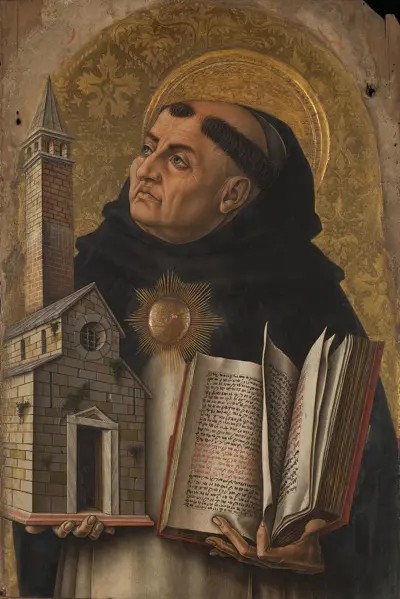
Thomas Aquinas was an Italian Dominican friar, philosopher, Catholic priest, and Doctor of the Church. An immensely influential philosopher, theologian, and jurist in the tradition of scholasticism, he is also known within the latter as the Doctor Angelicus, the Doctor Communis, and the Doctor Universalis. The name Aquinas identifies his ancestral origins in the county of Aquino in present-day Lazio, Italy. Among other things, he was a prominent proponent of natural theology and the father of a school of thought (encompassing both theology and philosophy) known as Thomism. He argued that God is the source of both the light of natural reason and the light of faith. His influence on Western thought is considerable, and much of modern philosophy developed or opposed his ideas, particularly in the areas of ethics, natural law, metaphysics, and political theory.
