Andrew Fletcher Quotes
Arms are the only true badge of liberty. The possession of arms is the distinction of a free man from a slave.
Andrew Fletcher, 1653-1716, Scottish Member of Parliament and Soldier, 1698, Cowan, Edward J. "Andrew Fletcher and the Scottish Radical Political Tradition." The Saltoun Papers: Reflections on Andrew Fletcher (2003): 149.
Sourced by: Eigen's Political and Historical Quotations


It would be more than a decade before the phrase “well regulated militia” would be added into the Constitution as the 2nd Amendment of the Bill of Rights. This resolution was the last of several passed at this meeting by which Maryland endorsed resistance to the British. So these resolations would have been widely distributed throughout the colonies and known by the leaders. In 1788 Alexander Hamilton Published Federalist 29 which also used the phrase. (See {588393}.) Then on September 25, 1789, the Congress proposed the Bill of Rights and the 2nd Amendment using the same key phrase, “well regulated militia.” Whether the drafters of the 2nd Amendment got the phrase from Hamilton’s Federalist 29 or from the Maryland Resolutions is not known but Hamilton’s was much more current. Did he get the phrase from Maryland? Did Congress get it from him? Did Maryland originate the phrase or was there an earlier use that influenced the Maryland drafters? At this point no one is sure, but the phrase is critical to the meaning of the 2nd Amendment because the Supreme Court has repeatedly held that the Second Amandment does not apply to individuals but only to the State’s right to bear arms within the “well regulated militia” and not as individual citizens. The right is that of the State government and that is why a state can control guns including banning them if they choose. So an individual in America does not have the constitutional right to bear arms. He may have a state constitutional right but in other states he may not use a gun in certain places and may not possess certain types of guns like hand guns which are illegal in New York, Washington DC and some other places.


At that time, ideology was not a driving political force and individual politicians often were hard to classify. For example, Humphrey was at the far left—an ultra liberal. Yet he was a staunch advocate of the right to bear arms. 50 years later there were no liberals who did not want to restrict gun ownership, And at that time, many Republicans were advocates of gun control, an unheard of situation in the 21st century beginning.


The first clause is exactly that used by the state of Pennsylvania in its constitution. These had no reference to the militia as did the Virginia Bill of Rights and later the Federal Constitution.


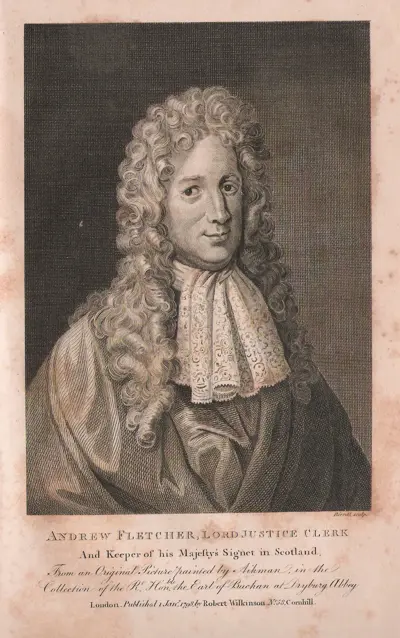
Andrew Fletcher of Saltoun was a Scottish writer and politician, remembered as an advocate for the non-incorporation of Scotland, and an opponent of the 1707 Act of Union between Scotland and England. Fletcher became an exile in 1683 after being accused of promoting insurrection. He was appointed the cavalry commander of the Monmouth Rebellion, but shortly after landing in England he killed another leading figure. He again went into exile, this time as a fugitive and with his estates forfeit. He returned with William of Orange, becoming Commissioner of the old Parliament of Scotland.
