Khalil Gibran Quotes
Are you a politician who says to himself, 'I will use my country for my own benefit?' If so, you are naught but a parasite living on the flesh of others. Or are you a devoted patriot, who whispers in the ear of his inner self, I love to serve my country as a faithful servant." Are you a politician asking what your country can do for you or a zealous one asking what you can do for your country?
See John F. Kennedy's famous 1961 inaugural quote {589867} for a more modern articulation targeted at all. The above quotation is from the Anthony R. Ferris translation of 1958. In an interesting play of influences, note the following Andrew Dib Sherfan’s 1975 translation done after the Kennedy inaugural address.
Khalil Gibran, 1883-1931, Lebanese Poet & Mystic, The Voice of the Master
Sourced by: Eigen's Political and Historical Quotations

This may be Kennedy’s most famous line. However he was not the first orator to express this idea however. See Khalil Gibran {601423}, Warren G. Harding {622594} and {629021}, St. John Broderick {595734}, and Oliver Wendell Holmes Jr. {603707} for earlier expressions of similar sentiments. Holmes seems to be the first to express the idea while the earliest seems similar phraseology seems to be the British Politician St. John Broderick in 1893 {595734}. Although, these earlier expressions existed, Theodore C. Sorensen, who assisted Kennedy with this speech and wrote the draft, had distilled it from earlier expressions and views of JFK and said that these were Kennedy’s words. At the time, he stated that was unaware of the Gibran, Harding, Broderick and Holmes sentiments. Gibran had not yet even been translated into English. However it is not clear whether Kennedy himself had inadvertently recollected the phrase from any of the other quotations. (The question was never put to him.) The St. John Broderick quotation is a possible source. Kennedy was quite familiar with British political history, and his father and been U. S. Ambassador to Great Britain. Regardless, the quotation was as great for the place and timing—his inaugural—as it was for the phraseology which might have originated elsewhere.

This quotation might have been an inspiration for the famous JFK quotation {589867}. See Khalil Gibran {601423}, Warren G. Harding {622594} and {629021}, and Oliver Wendell Holmes Jr. {603707} for similar sentiments. Holmes preceded Broderick by a few years, but Broderick came closest to the Kennedy phraseology.

This is a precursor to the famous JFK inaugural address quotation. See also, Khalil Gibran {601423} and Warren G. Harding {622594} and {629021}.

See John F. Kennedy {589867} for a later expression of this concept. Also Khalil Gibran {601423} and Oliver Wendell Holmes Jr. {603707}


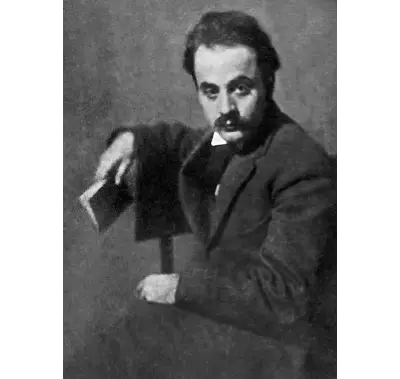
Gibran Khalil Gibran, usually referred to in English as Kahlil Gibran (pronounced /kɑːˈliːl dʒɪˈbrɑːn/ kah-LEEL ji-BRAHN), was a Lebanese-American writer, poet and visual artist, also considered a philosopher although he himself rejected the title. He is best known as the author of The Prophet, which was first published in the United States in 1923 and has since become one of the best-selling books of all time, having been translated into more than 100 languages.
