Ayn Rand Quotes
Any material element or resource which, in order to become of use or value to men, requires the application of human knowledge and effort, should be private property-by the right of those who apply the knowledge and effort.
Rand, Ayn. Capitalism: The Unknown Ideal. New American Library, 1966.

Sealed under duress and later repudiated by the King with Papal assistance. This clause was particularly interesting in that almost all freedoms have expanded from the Magna Carta in modern democracies. However in this one there was an absolute direct prohibition against the King—the State—taking private property without the owners consent. In modern democracies the right is not as strong as the original. The state, if it needs the property, wood or whatever, and the owner refuses to give it or sell it to the state, the government can condemn the property but must pay the owner the fair market value of the property seized. As a practical matter, the kings of England paid little or no heed to this clause. One of the sources of conflict between the English Royal Navy and the American Colonists was the practice of Naval agents finding tall straight trees, good for the main mast of a ship, and marking it thereby prohibiting the property owner of cutting down that tree until the Crown sent a crew to fell the tree and take it for ship building. They paid no attention to Aticle 31 whatsoever.


Use included renting it. What he opposed was simply holding land when whites were driving Indians off their lands because all the unused land outside of the reservation was owned by someone and the asking price was very high. Ingersoll was considered to be the greatest orator and political thinker of his day, but his overt atheistic views curtailed his elected political career.


50 years later a similar phrase was made famous be anarchist Pierre Joseph Proudhon.


Theoretically, this decree would have provided a fair amount of economic freedom for communist Russia. This decree gave some degree of comfort to the Western Europe and America, but had some major opponents within world communism who thought it too capitalistic. In practice the rights were never really available and this was one of the many “principles” of Soviet Communism which may have sounded reasonable but were never allowed to function in practice. Within a few years even the pretense of these principles was dropped.


The Catholic view on the subject varied from time to time, even with the same Pope. See {360616} for another quote from this Pope that gives a different point of view.

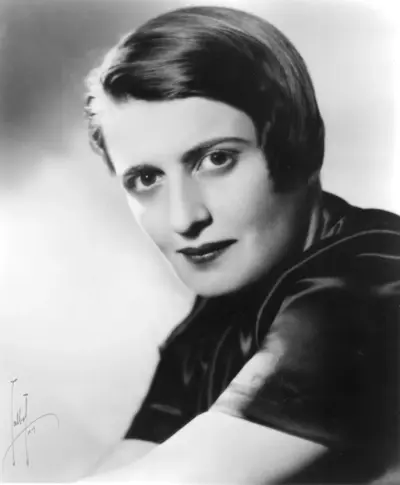
Ayn Rand was a Russian-American writer and philosopher. She is known for her two best-selling novels, The Fountainhead and Atlas Shrugged, and for developing a philosophical system she named Objectivism. Born and educated in Russia, she moved to the United States in 1926. She had a play produced on Broadway in 1935 and 1936. After two early novels that were initially unsuccessful, she achieved fame with her 1943 novel, The Fountainhead. In 1957, Rand published her best-known work, the novel Atlas Shrugged. Afterward, she turned to non-fiction to promote her philosophy, publishing her own periodicals and releasing several collections of essays until her death in 1982.
