Benjamin Franklin Quotes
And where is the Prince who can afford to so cover his country with troops for its defense, as that ten thousand men descending from the clouds, might not in many places do an infinite deal of mischief, before a force could be brought together to repel them?
Franklin, Benjamin. "Letter to Jan Ingenhousz, 16 Jan. 1784." The Writings of Benjamin Franklin, edited by Albert Henry Smyth, vol. 9, Macmillan, 1906, p. 155.


Plan Orange was the code name of the united states plan for possible war with Japan. In this ironic quotation, American military planners realized five years before Pearl Harbor that surprise attack was the major vulnerability. We were surprised and had no help from our intelligence service which despite the recommendations was almost nonexistent.

This quotation has significance for two reasons. First, Lodge was one of the leaders of the conservative isolationist wing of the Republican Party which generally only wanted to provide the military with weapons to defend the mainland. However, the technology of the airplane caused much rethinking. Americans had seen what German bombing had done to Spanish cities and Italian air power in Ethiopia. This followed by Germany bombing city after city throughout Europe. There were huge calls for antiaircraft guns to be placed around all American cities so that Americans might be defended from air attack. However, Lodge supported another strategy that was a first for America: retaliation. From this point forward, America would rely primarily on retaliation rather than massive defense until President Ronald Reagan proposed his ill-fated Star Wars defense scheme. The second significant factor is that the senator suggested preemption—the attack on a military air base is that threatens us. This appears to be another first.


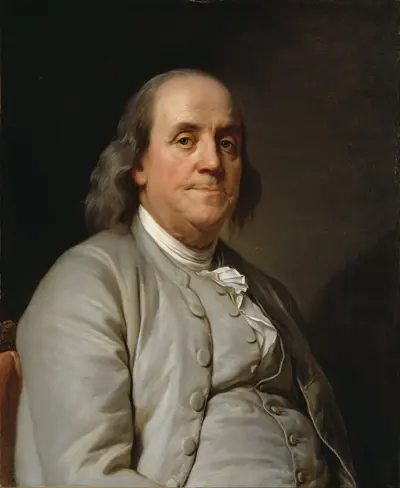
Benjamin Franklin FRS FRSA FRSE was one of the Founding Fathers of the United States. A polymath, he was a leading writer, printer, political philosopher, politician, Freemason, postmaster, scientist, inventor, humorist, civic activist, statesman, and diplomat. As a scientist, he was a major figure in the American Enlightenment and the history of physics for his discoveries and theories regarding electricity. As an inventor, he is known for the lightning rod, bifocals, and the Franklin stove, among other inventions. He founded many civic organizations, including the Library Company, Philadelphia's first fire department, and the University of Pennsylvania.
