Aristotle Quotes
And so long as they were at war, their power was preserved, but when they had attained empire they fell, for of the arts of peace they knew nothing, and had never engaged in any employment higher than war.
Aristotle. Politics. Translated by Benjamin Jowett, Clarendon Press, 1885, p. 60.


She had been asked what she had hoped to accomplish be killing Marat. Of all people Marat had been the most active and vigorous in calling for the beheading of thousands in the French Revolution. It was known as the Reign of Terror.

In the play the two characters are a Russian and American disarmament negotiator:


See Prince Otto von Bismarck-Schoenhausen {632620} for a similar focus on "iron and blood". This is no coincidence as Lindemann had been the Captain of the Battleship Bismarck.

The highest court in New York.

The notion of America flexing its military muscles and intimidating other nations by sending a fleet of 16 battle ships around the world was not greeted enthusiastically by some. However in Japan, the reaction was totally positive. The Russo-Japanese War had been ended thanks to the mediation of Theodore Roosevelt (for which he was awarded the Nobel Peace Prize) and America was a model for much of Japan’s modernization. 25 years later the Japanese would view America as an interfering, intimidating bully, curtailing their national aspirations and rights.

The non-communist forces of China were always struggling with each other for power. Attempts by non-communist reformers were defeated by autocrats, warlords, major landlords, and various religions organizations and denominations which were all fighting each other.


Voltaire made this quotation famous but he did not originate it. Roger de Bussy-Rabutin, another ho wrote it over 100 years earlier (See {596505} ). Sometimes the origin is attributed to Henri de la Tour d'Auvergne, Vicomte de Turenne, 1611-1675, a French General.

Haig was one of those who thought that President George W. Bush should have continued the war and occupied the country and the cities to eliminate Saddam. His own son, George W. Bush, later invaded Iraq and did occupy the country and eliminate Saddam, but the cost was so high that few Americans thought it was worth the cost in American casualties and money. The younger Bush proved how wise his father and Colin Powell had been. See {622764}.
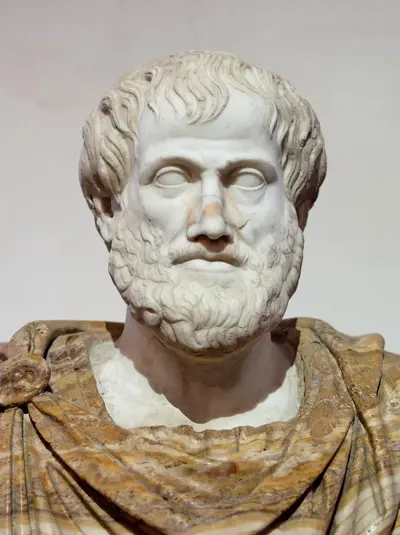
Aristotle (/ærɪˈstɒtəl/; Greek: Ἀριστοτέλης Aristotélēs, pronounced [aristotélɛːs]; 384–322 BC) was a Greek philosopher and polymath during the Classical period in Ancient Greece. Taught by Plato, he was the founder of the Lyceum, the Peripatetic school of philosophy, and the Aristotelian tradition. His writings cover many subjects including physics, biology, zoology, metaphysics, logic, ethics, aesthetics, poetry, theatre, music, rhetoric, psychology, linguistics, economics, politics, meteorology, geology and government. Aristotle provided a complex synthesis of the various philosophies existing prior to him. It was above all from his teachings that the West inherited its intellectual lexicon, as well as problems and methods of inquiry. As a result, his philosophy has exerted a unique influence on almost every form of knowledge in the West and it continues to be a subject of contemporary philosophical discussion.
