H. G. Wells Quotes
And all over the countryside, he knew, on every crest and hill, where once the hedges had interlaced, and cottages, churches, inns, and farmhouses had nestled among their trees, wind wheels similar to those he saw and bearing like vast advertisements, gaunt and distinctive symbols of the new age, cast their whirling shadows and stored incessantly the energy that flowed away incessantly through all the arteries of the city. ... The great circular shapes of complaining wind-wheels blotted out the heavens.
Wells, H. G. When the Sleeper Wakes. Harper & Brothers, 1899, p. 41.


His assertion that wind energy is less expensive than the fossil fuel alternative is not accurate if one accounts for the costs on the basis of conventional accounting methods. It was at that time more expensive which is why it’s use was limited. However, the existing methods of accounting did not charge the fossil fuels for the environmental degregation that they cause and the cost to society to overcome these or live with them. More important there is no charge to the cost of fossil fuels for the deleterious health effects that their extraction and use cause. Global warming / climate change is not considered at all in the economic analysis.


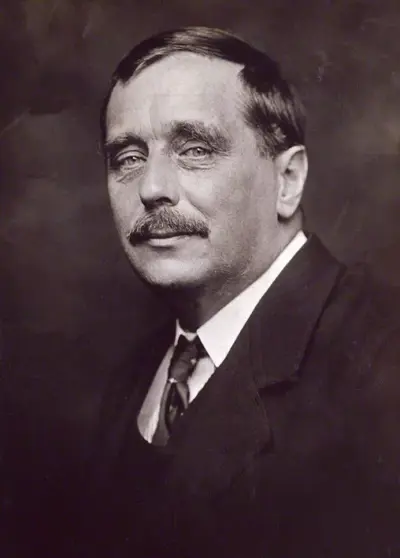
Herbert George Wells —known as H. G. Wells—was a prolific English writer in many genres, including the novel, history, politics, social commentary, and textbooks and rules for war games. Wells is now best remembered for his science fiction novels and is called a "father of science fiction", along with Jules Verne and Hugo Gernsback.[a] His most notable science fiction works include The Time Machine (1895), The Island of Doctor Moreau (1896), The Invisible Man (1897), and The War of the Worlds (1898). He was nominated for the Nobel Prize in Literature four times.
