New York Tribune Quotes
Although anti-Slavery is weak in political circles, it was never stronger with the masses of the people. The great heart of the country is sound. Thousands and millions of true men all over the North wait but the occasion for a practical demonstration of their power, to show how firm is their attachment to the principles of freedom, and how deeply they scorn the shallow fools who have the impertinence to talk about "crushing out" those principles. We expect to see Slavery go on pressing and pushing the advantages it derived from the adjustment of 1850, till a reaction is created that will again convulse the country to its center. Slavery is imperious, encroaching, truculent, belligerent. Its own conduct will thus ultimately generate an explosive force that must blow it to atoms.
New York Tribune, Editorial, January 6, 1854
Sourced by: Eigen's Political and Historical Quotations


This was Lincoln’s first anti—slavery speech and it was memorable


Lincoln was then a Whig campaigning for his party.

Baron Brougham and Vaux

The first anti-slavery newspaper published in the United States & the first journal in America to advocate immediate, unconditional emancipation
In this quotation Lincoln got out of the rhetorical trap that Douglas had set for him by disclosing his personal preferences as opposed to the positions that Douglas had accused him of being pledged to. See {615827}.
See Mark {606304}; also Matthew {606727}. Lincoln had used the “house divided” biblical metaphor in 1843 when arguing for Whig solidarity. The first political use of the Biblical metaphor and quotation with respect to American slavery appears to have been by Sam Houston in 1850 {603970}. The first use with respect to American slavery was byMassachusetts abolitionist, Edmund Quincy, in 1852. The second sentence of this famous quotation was forsaged earlier. See Lincoln, {619494} & {584918}. Also See Felix Rohatyn who used the Lincoln line to refer to poverty: {70611}.
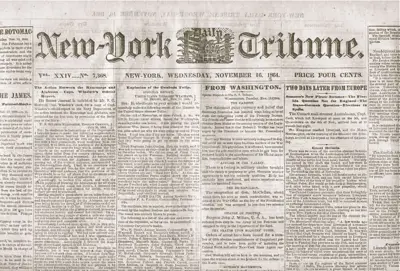
The New-York Tribune was an American newspaper, first established in 1841 by editor Horace Greeley. Between 1842 and 1866, the newspaper bore the name New-York Daily Tribune. From the 1840s through the 1860s it was the dominant Whig Party and then Republican newspaper in the United States. The paper achieved a circulation of approximately 200,000 in the 1850s, making it the largest daily paper then in New York City. The Tribune's editorials were widely read, shared, and copied in other city newspapers, helping to shape national U.S. opinion. It was one of the first papers in the north to send reporters, correspondents, and illustrators to cover the campaigns of the American Civil War.
