Urban II Quotes
All who die by the way, whether by land or by sea, or in battle against the pagans, shall have immediate remission of sins. This I grant them through the power of God with which I am invested.
Fulcher of Chartres. A Source Book for Mediaeval History. Edited and translated by Oliver J. Thatcher and Edgar Holmes McNeal, Charles Scribner's Sons, 1905, p. 517.

The so-called Second Crusade

In modern times there has been much criticism of the Muslim fundamentalists and the claim of the religious leadership that those who die in Holy War (Jihad) will immediately go to heaven. The concern is that this encourages terrorism and aggressive war. Yet, here we have virtually the same kind of “reward” for violence as issued by the Christians. See {611697} for another such example.


This sura is interpreted in two ways. For many modern Muslims it means that in discussions and debates on religion with non-Muslims, do not back off, and if you do it is a religious transgression. Defend the faith. For the fundamentalists and extremists, they interpret the same sura in physical warlike terms. So if there is a fight or battle with disbelievers, retreating from the battlefield is not only cowardice and perhaps a crime under military regulations as it is in the West, but it is in Christian terms a mortal sin for which there one will go to hell. So the most religious of Muslims will fight to the death using this sura as their guidance. On the other hand, Muhammad himself as the military and civil leader of Islam made strategic retreats. In the history of almost all warfare between the West and Muslims—especially the Arabs—courage on the battlefield has been lacking and the Israelis, British, French, Americans, and Hindus of India all observe this military weakness and accounting for this is built into their military doctrine.

The source was in the form of an autobiography but was written later by someone unknown. Prior to WWII and the German killing of over 25 million people, Tamerlane was responsible for more killings than any other ruler in the world. 17 million is generally given as the number if one analyses the Persian, Indian and other literature. He controlled the Middle East, the Ottoman States, a part of Russia and Eastern Europe, Persia and much of China and India. Although he himself was a Muslim he warred against other Muslim states and warlords defeating them all. Muslim nations are historically very ambivalent about Tamerlane. Pride as a conqueror is eclipsed by this excessive rapine and murder. In one case, the Persian city of Isfahan, he actually built a giant pyramid of 70,000 decapitated heads of prisoners. Also, the fact that he attacked and defeated major Muslim empires violates a current Muslim notion that there is a unity of Islam. He attacked, conquered and butchered the Ottomans, Syria, Iraq, Persia and the Muslim (Mugal) states of India.

Odo of Chatillon-Sur-Marne. Westerners who look with horror at the religious promises of Islamic clerics that suicide bombers and other Muslims who die “defending Islam” will immediately pass to Paradise without the usual requirements and judgments which might deny admission because of previous sins. However, this is exactly what the Christians did in the Crusades as this well documented quotation demonstrates. To see the Islamic version, go to {617166}

The Christian Crusaders then believed, like many Muslims even in modern times, that the person who dies in Battle defending God and the Faith shall ascend immediately to paradise. The Muslims threw in many virgins to go along with the ascendency, but the basic idea was the same.


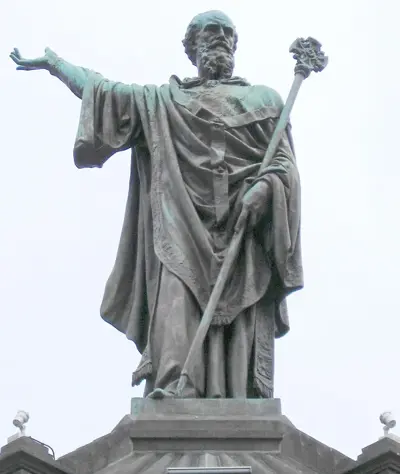
Pope Urban II, otherwise known as Odo of Châtillon or Otho de Lagery, was the head of the Catholic Church and ruler of the Papal States from 12 March 1088 to his death. He is best known for initiating the Crusades.
