Roger Bacon Quotes
All science requires mathematics. The knowledge of mathematical things is almost innate in us. This is the easiest of sciences, a fact which is obvious in that no one's brain rejects it; for laymen and people who are utterly illiterate know how to count and reckon.
Bacon, Roger. The Opus Majus of Roger Bacon. Translated by Robert Belle Burke, vol. 1, University of Pennsylvania Press, 1928, p. 118.


Feynman generally emphasized the importance of a scientist understanding the mathematics of his/her subject, especially where nature's complexities abounded. At the time few appreciated the importance in the biological sciences of mathematics which we know today is so essential.


Mathematical analysis is a much sounder method for determining truth than argument but it only is applicable where the real world fits the mathematical structures that we have which unfortunately is not enough to answer most of the political questions facing us.

For many scientists, this is the goal of each area of inquiry. For others, the science is crude and really not understood unless the mathematical model exists and can be verified experimentally. For Thompson, this was the difference between understanding and not.


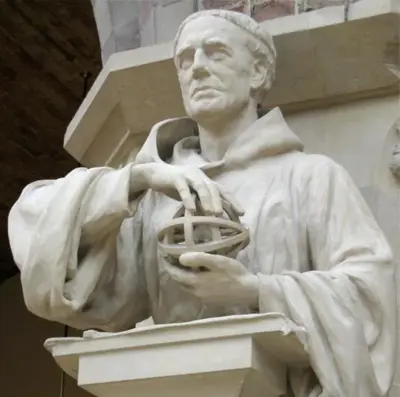
Roger Bacon (/ˈbeɪkən/; Latin: Rogerus or Rogerius Baconus, Baconis, also Frater Rogerus; c. 1219/20 – c. 1292), also known by the scholastic accolade Doctor Mirabilis, was a medieval English philosopher and Franciscan friar who placed considerable emphasis on the study of nature through empiricism. In the early modern era, he was regarded as a wizard and particularly famed for the story of his mechanical or necromantic brazen head. He is sometimes credited (mainly since the 19th century) as one of the earliest European advocates of the modern scientific method. Bacon applied the empirical method of Ibn al-Haytham (Alhazen) to observations in texts attributed to Aristotle. Bacon discovered the importance of empirical testing when the results he obtained were different than those that would have been predicted by Aristotle.
