Charles Lindbergh Quotes
Air power is new to all our countries. It brings advantages to some and weakens others; it calls for readjustment everywhere.
Lindbergh, Charles A. "Neutrality and War." Radio address, 13 Oct. 1939.


This quotation has significance for two reasons. First, Lodge was one of the leaders of the conservative isolationist wing of the Republican Party which generally only wanted to provide the military with weapons to defend the mainland. However, the technology of the airplane caused much rethinking. Americans had seen what German bombing had done to Spanish cities and Italian air power in Ethiopia. This followed by Germany bombing city after city throughout Europe. There were huge calls for antiaircraft guns to be placed around all American cities so that Americans might be defended from air attack. However, Lodge supported another strategy that was a first for America: retaliation. From this point forward, America would rely primarily on retaliation rather than massive defense until President Ronald Reagan proposed his ill-fated Star Wars defense scheme. The second significant factor is that the senator suggested preemption—the attack on a military air base is that threatens us. This appears to be another first.


This appears to be the first public call for Anti-Ballistic Missile Weapons & Systems. To many it is surprising that in 1946, there would be concern about missile defense, however during WWII, the Germans, violating the laws of war, struck London and other English cities with V2 rocket—the first ballistic missiles. England had suffered many civilian casualties and missile defense was a high priority for them.
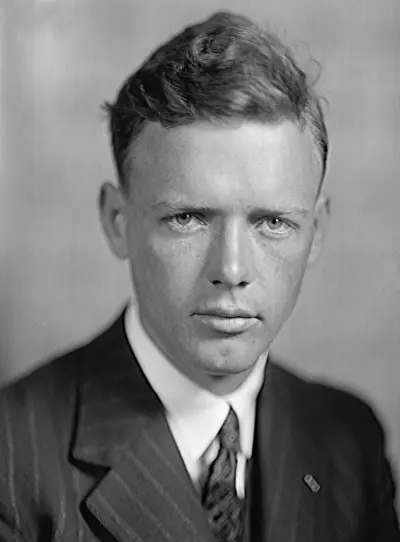
Charles Augustus Lindbergh, nicknamed Slim, Lucky Lindy, and The Lone Eagle, was an American aviator, author, inventor, military officer, explorer, and social activist. In 1927, at the age of 25, Lindbergh emerged from the virtual obscurity of a U.S. Air Mail pilot to instantaneous world fame as the result of his Orteig Prize-winning solo nonstop flight from Roosevelt Field on Long Island, New York, to Le Bourget Field in Paris, France. He flew the distance of nearly 3,600 statute miles (5,800 km) in a single-seat, single-engine, purpose-built Ryan monoplane, Spirit of St. Louis. Lindbergh was the 19th person to make a Transatlantic flight, the first being the Transatlantic flight of Alcock and Brown from Newfoundland in 1919, but Lindbergh's flight was almost twice the distance. The record-setting flight took 33 1⁄2 hours. Lindbergh, a U.S. Army Air Corps Reserve officer, was also awarded the nation's highest military decoration, the Medal of Honor, for his historic exploit. Politically, the National Hero became an active fascist supporter of Mussolini and Adolph Hitler who awarded him a Medal for Supporting Fascism, Anti-Semitism and advocating for America to allow Hitler to conquer German and the rest of Europe. After WWII he was in disgrace.
