Aristophanes Quotes
Ah! the Generals! they are numerous, but not good for much!
Aristophanes. The Acharnians. Translated by Eugene O'Neill Jr., Random House, 1938, p. 325.

General Shafter had a major attack of Gout, a terribly painful disease for which there was little relief at the time. As a result he had little involvement in the battle of Santiago at the most critical period. Crassus was an incompetent general in a famous Roman battle.

Hooker made some very poor decisions as far as Lincoln was concerned.

While running for office he was trying to win the support of Republcian Conservatives who were very unhappyt with their percieved lack of progress in fighting ISIS. However, this was insulting to many military people--especiually since ISIS was being deprived of they sources of funding and oil trade, their leaders were being killed at a rapid rate, and they were losign most of their territory. After he won the Presidency, on the very night of his inaguration he then flip flopped and paraised the general leadship of the military. While most politicans had a certain degree of hypocricy, Trump could make totally contrdictory statements without any embarassment. See Quote 644331..

It was almost unheard of for generals and retired generals to criticize the administration publicly, but the George W. Bush Administration polarized not only the country as a whole but the military as well.


We are so accustomed to thinking about George Washington as a great military leader that it is surprising to see contemporary comparisons where Washington was found wanting or second. Actually Horatio Gates was a brilliant tactical general and a great leader of men—many think far better than Washington, but the genius of Washington was his strategic and political grasp of the situation. Essentially, with exceptions like the Battle of Trenton, Washington lost almost all the battles he fought as a tactical general. He realized early on that he did not have to win battles; he just had to prevent losing them so badly that he could not continue the fight. The insurgent wins as long as he can still fight. The British could not win unless they eliminated the ability of the revolutionists to fight. But Washington won the last battle at Yorktown, and that is the one that counted. Rush ran the hospitals for the Revolutionary Army and talked to many officers and enlisted men, and also observed much of the British military practices.

He polished the army but had little strategic appreciation for the strengths of the Union, its industrial capability, logistical capability, and its greater manpower pool. He was reluctant to fight, and when he did, was happy to take territory, that meant little, when Lincoln and other strategists argued that the object should be to destroy and degrade the Confederate Army and the Confederate capacity to support the Army and continue to make war.

McClellan found many reasons to avoid engaging the Southern forces, and when battles could not be avoided, he would never pursue the enemy after an engagement but would regroup. Much public opinion was unhappy with McClellan, but he had great support among the Democrats who were not supporters of the war. Finally Lincoln fired McClellan who then ran as a Democrat against the President in 1864. McClellan looked and talked like a great general but was much averse to fighting. Once rid of McClellan, the Union Army began to have success although losses on both sides were horrendous.

Most people are surprised that Lee suggested his being replaced when his army lacked military success. Strategically, he had a hopeless task. The incompetence of General McClellan and other Union Generals is the only reason that the war lasted as long as it did. However, Lee got about as much as any military commander could have given the greater manpower, industrial production, communications and transportation of the Union to say nothing of the much superior technology.

The General refused. He had already achieved a strategic victory and it was only a matter of time when the Dutch would withdraw on their own as their supply lines were cut off and the populations wanted them out.

He was objecting to the current crop of senior military officer who have little experience in fighting and much in academic, strategic and technical training. Many however see him as a dinosaur who does not realized the complex nature of the modern military missions. In general, we have won almost all of our fighting battles but often failed in our maintaining civil society, occupation, nation building, military procurement, preventing sexual assault of our own troops by our own soldiers, assuring mental health of our soldiers. Hackworth, detractors argue, wants to change what already works and ignore what does not.


“Hapsburg” was the family name of the Emperors of the Austro-Hungarian Empire. As typical of a heredity absolute monarchy, it was accompanied by a heredity aristocracy from which all the generals and senior officers of the military were selected. Their social graces and skills were assured but not their capability as leaders of any kind—especially military officers.


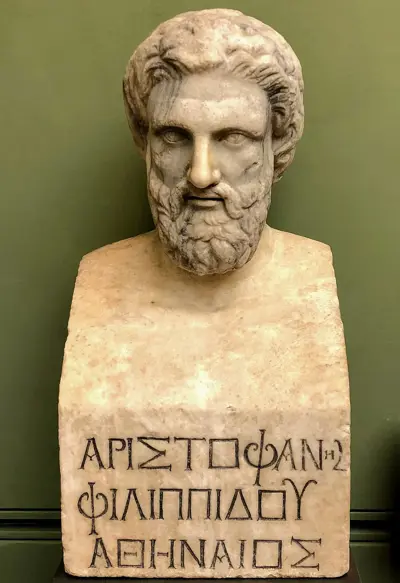
Aristophanes (/ˌærɪˈstɒfəniːz/; Ancient Greek: Ἀριστοφάνης, pronounced [aristopʰánɛːs]; c. 446 – c. 386 BC), son of Philippus, of the deme Kydathenaion (Latin: Cydathenaeum), was a comic playwright or comedy-writer of ancient Athens and a poet of Old Attic Comedy. Eleven of his forty plays survive virtually complete. These provide the most valuable examples of a genre of comic drama known as Old Comedy and are used to define it, along with fragments from dozens of lost plays by Aristophanes and his contemporaries.
