Calvin Coolidge Quotes
After all, the chief business of the American people is business. They are profoundly concerned with producing, buying, selling, investing and prospering in the world.
Coolidge, Calvin. "Address Before the American Society of Newspaper Editors, Washington, D.C., January 17, 1925."


Although England had benefitted more from the industrial revolution than most nations, the English Aristocracy and its intelligencia saw business as inherently corrupt with minimal ethical standards and almost no transparency. See {629121} for a Christian religious version of this secular quotation.


Sometimes this is misquoted as 'The business of America is business.' See Woodrow Wilson for an earlier statement of this idea which is almost always incorrectly attributed to Coolidge as the originator of the idea.

Executed by the English for his part in the Easter Uprising. Although a century ago, Connolly captured the centrality of the development problem of every Third World County trying to compete in a global economy. The irony is that Ireland, long after achieving Independence, had the lowest standard of living in Europe for years. The great Irish breakthrough came as the result of the government making a huge national investment providing the capital for giving all of Ireland access to the Internet and passed laws for the information age. The Irish people took it from there. They leapfrogged wealthier nations and found customers all over the globe because they had the infrastructure to reach the rest of the globe just as fast as anyone else. See {589760} for Connolly’s idea to bring technology of the time to Ireland. The Irish information revolution was accomplished by using this idea for information technology instead of farm technology.


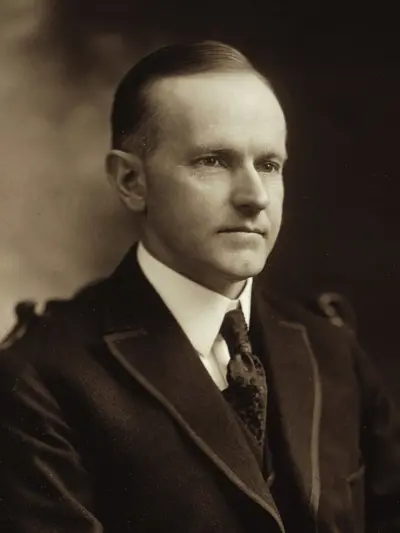
Calvin Coolidge was an American lawyer and politician who served as the 30th president of the United States from 1923 to 1929. A Republican lawyer from New England, born in Vermont, Coolidge worked his way up the ladder of Massachusetts state politics, eventually becoming governor of Massachusetts. His response to the Boston Police Strike of 1919 thrust him into the national spotlight and gave him a reputation as a man of decisive action. The next year, he was elected the 29th vice president of the United States, and he succeeded to the presidency upon the sudden death of Warren G. Harding in 1923. Elected in his own right in 1924, he gained a reputation as a small-government conservative and also as a man who said very little and had a rather dry sense of humor.
