Arthur Eddington Quotes
A star is drawing on some vast reservoir of energy by means unknown to us. This reservoir can scarcely be other than the subatomic energy which, it is known exists abundantly in all matter; we sometimes dream that man will one day learn how to release it and use it for his service. The store is well nigh inexhaustible, if only it could be tapped. There is sufficient in the Sun to maintain its output of heat for 15 billion years.
Eddington, Arthur S. "The Internal Constitution of the Stars." The Scientific Monthly, vol. 11, no. 4, 1920, p. 304.


Rutherford had been the first to split the atom in 1919.

There was massive opposition to nuclear power in most countries of the world except France where the operators and technicians are so well trained and there are such high safety standards that the public had confidence in the nuclear management that did not exist in most other countries.
Nuclear fusion is different from nuclear fission that currently powers atomic power plants. Fusion is the process the sun uses to generate all its power. Scientists understand exactly how fusion works—it’s much simpler than fission, but actually creating a way of doing it on earth has been a very difficult challenge. The National Ignition Facility has been trying to produce a fusion reaction for a number of years with no success.

The lecture was on radium and the radioactivity that scientists had recently discovered. This appears to be the first time a scientist suggested the possibility of using atomic energy to produce a powerful weapon. At the same time, note that he also mentioned the possible destruction of the earth. “Heavy matter” referred to the elements—many of which had not yet been discovered—that had larger atomic numbers than radium like uranium.


Meitner and her nephew Frisch had been the first people to realize that the atom had been split. Meitner had described the process to her nephew and he made some drawings of the process she described. A few of these looked like a bacteria dividing. Frisch happened to meet with William A. Arnold, an American Biologist doing research in Stockholm. He asked Arnold what the biologists called it when a bacteria divided, and he replied, “fission”. Frisch told his aunt and she decided that they should use that term in the scientific article they were preparing on the splitting of the atom.


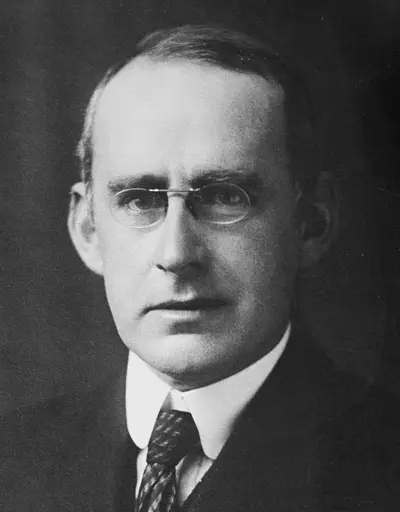
Sir Arthur Stanley Eddington OM FRS was an English astronomer, physicist, and mathematician. He was also a philosopher of science and a populariser of science. The Eddington limit, the natural limit to the luminosity of stars, or the radiation generated by accretion onto a compact object, is named in his honour.
