Henry McNeal Turner Quotes
A singular fact is, that anybody, white or colored, from America is welcomed out here in Africa, either on the coast or back in the interior. While Englishmen, French and Germans are mostly hated. The kings hate them, especially about robbing them of their lands. The French are hated as the devil. Americans are looked upon as their guardians…and the friends of blacks, … I do not understand it yet. France is more prejudiced and more intolerant in her claimed possessions than England and seems far less compromising.
He goes on to observe that the German’s are the most hated of the Europeans in large part because they mainly trade in rotgut liquor much of it poisoned which has a devastating effect on the Africans. (The English, in contrast had to have all alcohol inspected in London for safety, before it could leave for Africa.) The “kings” to which the Bishop referred are the rural tribal kings of whom there were more than a few. It is not as if there were a unified monarchy. Another interesting observation is that although Turner was one of Americas leading Blacks, he used the term frequently, but never capitalized it.
Henry M. Turner, 1834-1915, Minister and Bishop, African Methodist Episcopal Church, Co-Founder, Georgia Republican Party, Vice President, American Colonization Society, Letter from Freetown, Liberia, November 16, 1891
Sourced by: Eigen's Political and Historical Quotations

Disraeli was the 1st Earl of Beaconsfield

Describing the ethnic immigration quotas that Congress was debating in 1924:


Mather was urging the community to protect their children against the Devil and his band. To exemplify just how terrible Devils were to his audience, he used a comparison to the worst thing the audience was familiar with—Indians. Although there were a few examples in Colonial America of Indians being perceived as benign or even people, they were few and far between, and tended to be in New York and Pennsylvania.

Chvalkovsky had just returned from Berlin where he had met with Hitler and German Foreign Minister Ribbentrop. He related the meeting to the French Ambassador who reported it to the French Foreign Minister by letter.

Brant had an English style Missionary education and was an Anglican, belonging to the Church of England. During the American Revolution, he persuaded most of the Iroquois tribes to fight for the British against the revolutionary colonists. However, the Oneida tribe was not persuaded and joined the rebel side. A few New England Presbyterian missionaries had targeted the Oneida people, and when that tribe chose the “wrong” side, Brant believed that the reason was their different religious point of view. After the Revolution, Brant and his Iroquois followers were driven out of their American lands and escaped to Canada, while the Oneida were given complete title to their lands by George Washington.
The Germans had just passed a law making it illegal for a Jew to work as a teacher, professor, government official, scientist, or researcher. Szilard, a Jewish Hungarian politically astute physicist who was working in Germany was trying to organize a plan for the rescue of the Jewish German scientists—to place them in scientific or teaching positions in other countries. Kuhnwald, himself a Jew, was not only a very experienced politician, but one who had been following the Nazi Germany political scene “next door” to predict the future effect on Austria.
Louis Napoleon Bonaparte. The “colonies” to which we was referring were the French Colonies in the Caribbean—particularly Haiti. The Black slaves had revolted against the slave-owners and had taken over all positions of authority and wore the uniforms and symbols of power including the epaulettes—the gold braid shoulder pieces that were symbols of high rank in military and diplomatic uniforms which were worn on all official occasions. Napoleon never did make good on his vow. He had many more problems with his own wars and governance in Europe. This quote does demonstrate the racism that existed in supposedly tolerant France.


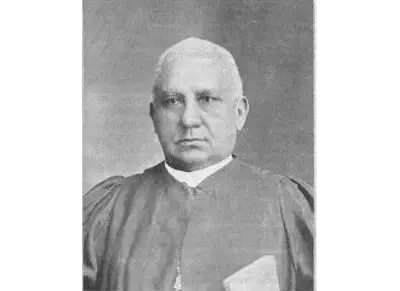
Henry McNeal Turner was an African-American minister, politician, and the 12th elected and consecrated bishop of the African Methodist Episcopal Church (AME). After the American Civil War, he was a pioneer in Georgia in planting new A.M.E. congregations among African Americans there. Born free in South Carolina, Turner learned to read and write and became a Methodist preacher. He joined the AME Church in St. Louis, Missouri, in 1858, where he became a minister. Founded by free blacks in Philadelphia, Pennsylvania in the early 19th century, the A.M.E. Church was the first independent black denomination in the United States. Later Turner had pastorates in Baltimore, Maryland, and Washington, DC.
