Adam Smith Quotes
A power to dispose of estates for ever is manifestly absurd. The earth and the fulness of it belongs to every generation, and the preceding one can have no right to bind it up from posterity. Such extension of property is quite unnatural.
Smith, Adam. Lectures on Jurisprudence. Edited by R. L. Meek, D. D. Raphael, and P. G. Stein, Clarendon Press, 1978, p. 468.


See Thomas Paine for a contemporary similar view and Auguste Comte for an earlier statement of the consequences of the contrary.

Primogeniture is the system where property is inherited from the father to the first born son. At the time women could not own property unless they were widows. It is the basis of most aristocracies. See {627010} for an American view of primogeniture that was stated a little earlier.


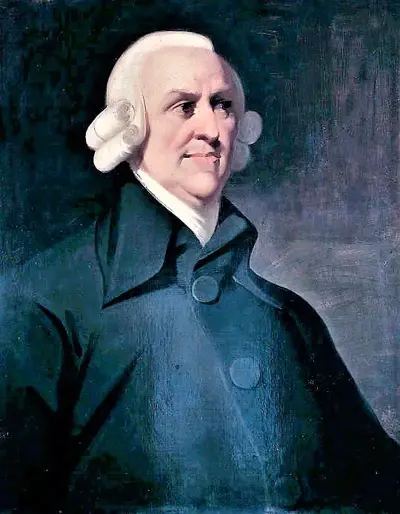
Adam Smith FRSA was a Scottish economist, philosopher as well as a moral philosopher, a pioneer of political economy, and a key figure during the Scottish Enlightenment, also known as ''The Father of Economics'' or ''The Father of Capitalism''. Smith wrote two classic works, The Theory of Moral Sentiments (1759) and An Inquiry into the Nature and Causes of the Wealth of Nations (1776). The latter, often abbreviated as The Wealth of Nations, is considered his magnum opus and the first modern work of economics. In his work, Adam Smith introduced his theory of absolute advantage.
