McGeorge Bundy Quotes
A nuclear exchange confined to military targets seems more possible, not less, when both sides have a sure second strike capability. Then you might have a more stable balance of terror.
McGeorge Bundy, 1919-1996, Presidential Assistant for National Security (Democrat), Interview, The Saturday Evening Post, December 1, 1962
Sourced by: Eigen's Political and Historical Quotations


This quotation is very important in helping to understand the 1950s in America with respect to nuclear weapons policy. McCormick was one the better educated, sophisticated, and influential Americans. Yet he appears to be a technological and nuclear ignoramous. Most people had not yet realized that atomic weapons were not just much larger traditional bombs. They could do terrible damage, but it would always be localized they thought. Chicago might be destroyed but the people out of range would be OK. He never got it that a dirty bomb could be dropped on Detroit and depending on which way the wind is blowing could wipe out Chicago and much of the Midwest as well. He knew nothing of the genetic effect the radiation, nor the implications for the environment of maintaining a large nuclear manufacturing industry. He and many like him did not realize that after the first bombs were created, how easy it would be for the Russians and others to also develop a nuclear arsenal. And 50,000 warheads was just a matter of effort. The implications of these things would inhibit our carrying out his and others ideological views of foreign policy. Oppenheimer and most nuclear scientists explained all this, but believing them and acting on those beliefs would have been too much of a change.


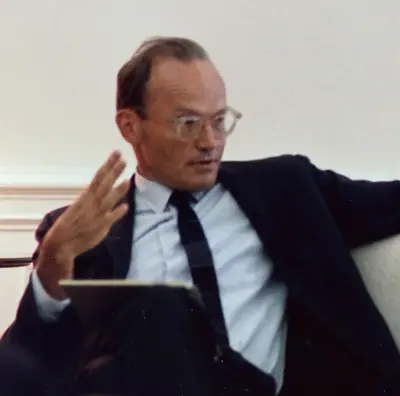
McGeorge "Mac" Bundy was an American academic who served as United States National Security Advisor to Presidents John F. Kennedy and Lyndon B. Johnson from 1961 through 1966. He was president of the Ford Foundation from 1966 through 1979. Despite his career as a foreign-policy intellectual, educator, and philanthropist, he is best remembered as one of the chief architects of the United States' escalation of the Vietnam War during the Kennedy and Johnson administrations.
