Donald Knuth Quotes
A mathematical formula should never be "owned" by anybody! Mathematics belong to God.
Knuth, Donald E. Letter to Commissioner of Patents and Trademarks. 23 Feb. 1994.


This doctrine of law was settled, but in the technological and digital age some people have tried to extend the intellectual property doctrine to include some ideas if they idea is a procedure or a set of DNA instructions. Meanwhile, the legal doctrine has been and is, as stated by Brandeis in this quotation, is that new and original ideas are not intellectual property and are always in the public domain, no matter how original.


Even before being an independent country, America had two contrasting and contradictory views of patents—the one that Franklin herein states and the one what was written into the constitution that argued that by granting patents inventors would be incentivized to make their trade secrets public if they had an exclusive monopoly on if for a period of time. Both of these philosophies towards patents have coexisted since then. There was a Federal patent system for those who wanted to use it, and for those who did not, they could enter the invention to the public domain as Franklin urged. Arguably, we have obtained the best of both approaches. Millions of patents have been filed and granted and yet some of the most important inventions have followed the Franklin approach. See the quotes about the Salk Polio Vaccine—{29154} and {29187} and the quote on "open source" computer software—{29676}. With billions of dollars being made by protected software in the early 21st century, over half of the world's computers were operating on systems that was public domain and without charge as just one large example of the Franklin philosophy still coexisting.


This seemingly beneficial objective began to develop serious opponents as Google began to index more and more of the knowledge of the society. Vested copyright interests, scholars, civil libertarians, privacy advocates, and forces in control of information all discovered consequences.

Many people believe that patents—especially in the high technology arena—actually inhibit innovation.


When Secretary of State, Jefferson ran the first American Patent Office. The Patent system was originally and educational program, not an intellectual property program. Inventors would keep all their technological secrets to themselves. The idea behind the original patent system was to give an inventor a limited monopoly on profiting from his invention in exchange for sharing his information and techniques with his countrymen—thus improving the technological competency of the entire society. The very first patents were available for public inspection for that reason. And even today, copies of patents are available easily for almost no cost. And few American ideas worked as well as our early patent system. Through its educational role and technology transfer, America came from technological nowhere to being the pre-eminent inventing nation of the world. The balance between public access to invention and innovation and preservation of some rights to the creator of intellectual property is key to modern development.

This quotation is an excellent statement of one major viewpoint about patents. However there are others who disagree and many who believe the existing patent system is broken and inhibits innovation. They observe that the vast majority of patents never are developed or reach the public. They also point to major counter-examples to Thomson’s view. The best is the PC which IBM developed and decided NOT to patent it, to encourage people to produce programs, applications and many devices. No product in human history has been more thoroughly developed and adopted by as many people as quickly. More capital investment money has been invested that any other invention. There are many examples where Thompson’s point holds. Vaccines for which there is no patent have not obtained any company who would manufacture it despite the need. The issue is complex with the old view of Thomson certainly not correct, but not entirely wrong either.

Stallman and others opposed copywriting of software and felt that computer programs were ideas and as such should not be able to be legally monopolized but they had to live with the law as it was. They started the open source software movement where many programmers developed software and made it freely available to the world. However, there were many companies who would take the free software which was very good, package it with their own brand and sell it. Stallman then created the copyleft concept. This meant that the open source programmers legally copyrighted the program and then created a license that anyone could have for free. But the license only gave them the right to use the software or give it freely to others. Charging money would be a copyright violation. So he and many others since used the copyright law to prevent others from interfering with or making money from distribution and Stallman named it “copyleft” meaning the other side of copyright. Thousands of major programs have been distributed this way. In some areas. It has been so successful that the free software became much more widely used than the products of Microsoft, Oracle or any of the other commercial software developers. Website development has become an example. Not only do many use it because the price is right but much of the open source free software is the best of breed. The Obama White House used a copyleft, free program for the White House website, not because they would save money—the Clinton White House had already licensed excellent commercial software. They chose the open source Drupal package because they thought it was the best available at any price.


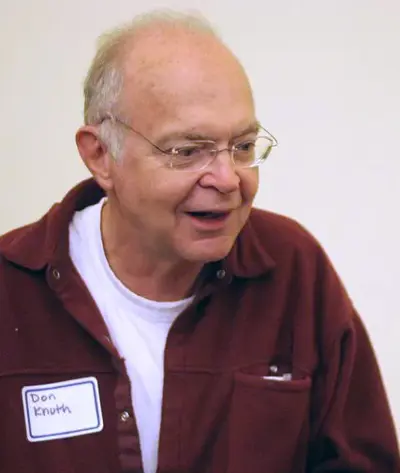
Donald Ervin Knuth is an American computer scientist, mathematician, and professor emeritus at Stanford University. He is the 1974 recipient of the ACM Turing Award, informally considered the Nobel Prize of computer science. Knuth has been called the "father of the analysis of algorithms".
