A. P. Herbert Quotes
A man who has made up his mind on a given subject twenty-five years ago and continues to hold his political opinions after he has been proved to be wrong is a man of principle; while he who from time to time adapts his opinions to the changing circumstances of life is an opportunist.
Alan Patrick Herbert, 1890-1971, British Writer & Member of Parliament, "Which Is the Liberal Party?", Uncommon Law, 1935
Sourced by: Eigen's Political and Historical Quotations


See {627632} for an earlier advocy of change when circumstances warrant and {636175} for a modern view.

Most politicians would never do this. Ideologues rarely analyze their beliefs. Pragmatic politicians are fearful of being called a flip flopper with no core principles. However, some politicians follow this advice. For example, Abraham Lincoln and Franklin Delano Roosevelt were both among the rare politicians who would frequently change positions as they learned more. See John Maynard Keynes {619441} for a personal statement of this principle and {636175} for a modern view.

He had originally said he would only serve one term as UN Secretary General. He then decided to go for another term. The press accused him of flip flopping. See {619441} and {627632} for a similar view.


Apology and explanation for reversing his former view on an issue


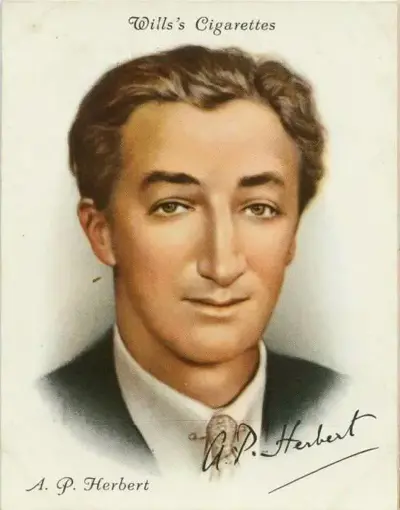
Sir Alan Patrick Herbert CH, usually known as A. P. Herbert or simply A. P. H., was an English humorist, novelist, playwright and law reform activist, and an Independent Member of Parliament for Oxford University from 1935 until 1950, when university constituencies were abolished. Born in Ashtead, Surrey, Herbert attended Winchester College and New College, Oxford, graduating with a starred first in Jurisprudence in 1914. He joined the Royal Naval Volunteer Reserve as an ordinary seaman in World War I, later serving as an officer with the Royal Naval Division. He fought in Gallipoli and on the Western Front, becoming battalion adjutant in 1917, before injury excluded him from the front line. After the war, he published The Secret Battle and joined the staff of Punch in 1924. He also wrote librettos for musicals. Elected as Independent MP for Oxford University in the 1935 general election, Herbert campaigned for private member's rights, piloted the Matrimonial Causes Act 1937 through Parliament, opposed the Entertainments Duty, and campaigned against the Oxford Group. He joined the River Emergency Service in 1938 and served in World War II as a petty officer in the Royal Naval Auxiliary Patrol. He captained his river boat, the Water Gipsy, on the River Thames. In 1943, he joined a parliamentary commission to investigate the future of the Dominion of Newfoundland.
