James Surowiecki Quotes
A general principle of good taxation is that similar jobs, and similar kinds of compensation, should be taxed the same way: otherwise, the government is effectively subsidizing some jobs over others.
Surowiecki, James. "The Financial Page." The New Yorker, Condé Nast.


As a result of years of lobbying many vested interests were getting tax exemptions for their activities. Some of the richest corporations and people paid little or no taxes. This was like the old European monarchies where the dukes and nobles got tax exemptions from the king and the middle class and poor people paid a much larger percentage of their income and wealth than did the nobility. Fairness in taxation is very difficult in practice. See {633629}


The founder was Charles E. Coughlin, 1891-1979, a demagogic Catholic Priest who drafted the principles and invited others to join him. Hundreds of thousands did in this organization which began in idealism, and ended in scandal and hate mongering, so much so that Father Coughlin was ordered off the radio and out of politics by the Catholic Church. The National Union in 1936 had morphed into the Union Party which ran Presidential candidates in the 1936 election. At the time, a progressive income tax was an anathema to most people, however it became the norm in later years and although the idea did not originate with the Union, was one of the few lasting contributions of the Union.


Throughout most of the world, the rich and the aristocrats have been able to reduce or eliminate their tax obligations with the burden falling more heavily on the common people. Progressive taxation was thought to be a solution, but even in the United States by the 21st century many huge corporations paid little or no taxes while there was a heavy tax burden on small companies. Rich people generally paid a smaller percentage of their income than middle class people.

Corporate and business taxes were anathema to Republicans in 1899 as they were a century later. Roosevelt shocked the Republican base with statements like this, and when he implemented them, he became the most popular politician in America—possibly even more so than George Washington.


The nation rejected the flat tax that was favored by conservatives in the 1930s. However, in the Republican Presidential Primary Campaign of 2000, candidate Steve Forbes made the flat tax a centerpoint of his campaign. He lost badly, but the idea caught on amongst some conservative Republicans, and has had some support since.


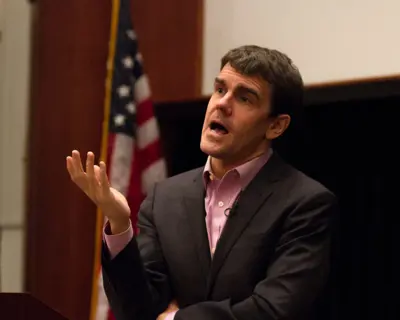
James Michael Surowiecki is an American journalist. He was a staff writer at The New Yorker, where he wrote a regular column on business and finance called "The Financial Page".
