Willard Van Orman Quine Quotes
A fancifully fancyless medium of unvarnished news.
Willard van Orman Quine, 1908-2000, Philosopher & Logician, "Word and Object
Sourced by: Eigen's Political and Historical Quotations


Husayn Ali Nuri


He always found something positive to report.
The Democrat campaign operators, led by Robert Woolley, for the first time in an American Presidential campaign, used all the new techniques of public relations and advertising that had been developed. Many observers like the New Republic editors saw this in a negative light for American democracy. They wanted the old method where people met the candidates and had discussions with candidates or heard from others who had. It was in retrospect an editorial of nostalgia, as the country was growing so much that voter “acquaintance” with Presidential candidates was becoming more and more difficult.


Many scholars believe that complete objectivity is impossible psychologically. Hence, neutrality is a better standard and goal some argue.

She did not know it at the time but an entire brigade of American volunteers fought for the republicans against the Fascists—It was called the “Abraham Lincoln Brigade”. They believed that the Fascists would have to be stopped and the earlier it could be done the better off the world would be. Many of them died fighting for their own convictions. Millions of more Americans would follow them, fight for their own convictions, and finally defeat the fascists.
This particular column brought criticism from some on the left who were distressed that a First Lady might be trying to intimidate the press. Mrs. Roosevelt was, like her husband, not wed to any particular dogma or ideology’ they were practical, common sense politicians who distrusted dogma of any kind.

Samuel Langhorne Clemens, 1835-1910

The 1980 presidential campaign was held in the middle of the Iran hostage crisis. President Carter remained in the White House and left the campaigning to the Vice President who received very light news coverage:
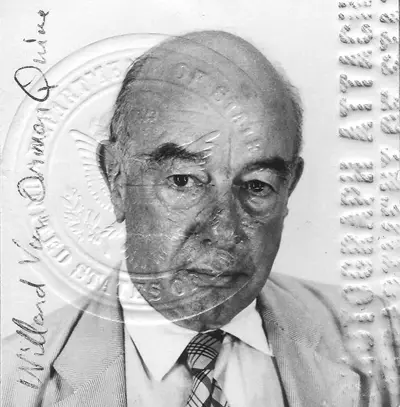
Willard Van Orman Quine was an American philosopher and logician in the analytic tradition, recognized as "one of the most influential philosophers of the twentieth century." From 1930 until his death 70 years later, Quine was continually affiliated with Harvard University in one way or another, first as a student, then as a professor. He filled the Edgar Pierce Chair of Philosophy at Harvard from 1956 to 1978.
