Saint Augustine Quotes
… a devout Christian must avoid astrologers and all impious soothsayers, especially when they tell the truth, for fear of leading his soul into error by consorting with demons and entangling himself with the bonds of such association.
This is a very interesting quotation for it is a stark illustration of a difference between science and many religions that exists, albeit to a lesser extent. The Church fathers had decided that astrologers and alchemists were in league with the Devil and therefore were to be avoided and not heeded. But Augustine clearly tells us that this is so, even of the astrologers / alchemists were right and had the truth. To the scientist the truth trumps all else. To Augustine, avoiding contamination with the Devil—heresy—is more important than learning the truth. The same sort of logic has been a part of much political culture. When the Communists would decry American Racial discrimination, much of the society claimed that, their ideas should not be considered. Communists were evil and to be shunned—even if they were right about a particular area. To the Tea Party of the early 21st century, elite liberals were to be shunned and discounted even if they sometimes had the truth on their side. The origin of the thinking is with Saint Augustine.
Saint Augustine, 354-430, Bishop of Hippo, Christian Church Father & Philosopher
Sourced by: Eigen's Political and Historical Quotations


This verse has been one of the bases of Muslim theocratic states like Iran’s claim to legitimacy. The word “govern” is sometimes translated as “judge.” In the context of the 6th century, there were no separation of powers as we know them and judging, governing and legislating were melded.

Quintus Septimius Florens Tertullianus

He was persecuted by the Roman Catholic Church for figuring out that the earth revolved around the sun which was contrary to church teaching at the time.

The Church exercised the law enforcement and censorship authority in all Catholic countries. Note the offense of saying anything which is “offensive to pious ears”. The particular example that “offended” the pious was that a heretic should not be executed. These were the cultural values of the day.
He was officially hanged for his offence of making this statement on January 8, 1697. His execution, which raised considerable concern, was the last execution for blasphemy in Britain.

He offended the Rabbis ofr Amsterdam by extolling the concept of salvation and Jesus Christ, and he offended the Priests with the last sentence. Much of his theology also offended the Muslims. Spinoza’s ideas were considered so radical and dangerous that he was the only man in history who was excommunicated by the Catholics, the Jews and the Muslims.


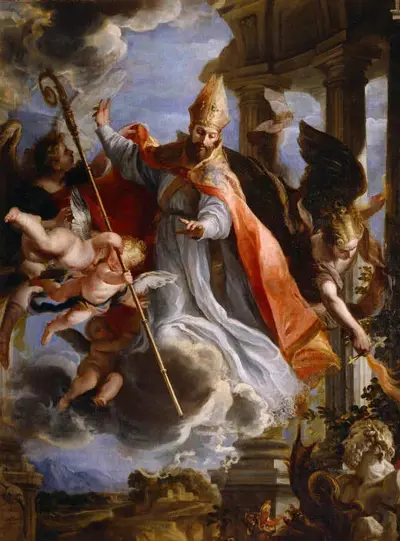
Augustine of Hippo, also known as Saint Augustine, was a theologian, philosopher, and the bishop of Hippo Regius in Numidia, Roman North Africa. His writings influenced the development of Western philosophy and Western Christianity, and he is viewed as one of the most important Church Fathers of the Latin Church in the Patristic Period. His many important works include The City of God, On Christian Doctrine, and Confessions.
