Fyodor Dostoevsky Quotes
A beast can never be as cruel as a human being, so artistically, so picturesquely cruel.
Dostoevsky, Fyodor. The Brothers Karamazov. Translated by Richard Pevear and Larissa Volokhonsky, Farrar, Straus and Giroux, 1990, p. 238.


Samuel Langhorne Clemens, 1835-1910


He was finally brought to justice after being protected by the right wing for many years. He was sentenced to 25 years in prison. See related quote.

A Cossack revolt had broken out in 1707 and was put down by the Czar’s forces. He then issued what might be one of the first official orders for genocide. Few Cossacks survived.


by recent Southern military losses Ironically, it was the Southern States and Southern politicians who had ever since President Andrew Jackson, illegally appropriated most of the Indian lands. It was the Supreme Court who ordered Jackson not to remove the Cherokee, but he and the other Southerners did so anyway with mild protest coming from the North. Neither section treated the Indians fairly, but the South had been much worse.

This and other quotations like {640611} and {640616} show that the State Department knew that Mobutu Sese Seko, the man we were backing in the Congo had many very undesirable characteristics for a dependable foreign ally and one who would be given control of billions of American money. Yet nothing was done and we continued to support him despite the kleptocracy and the instability that undermined his regime and the United States along with it.


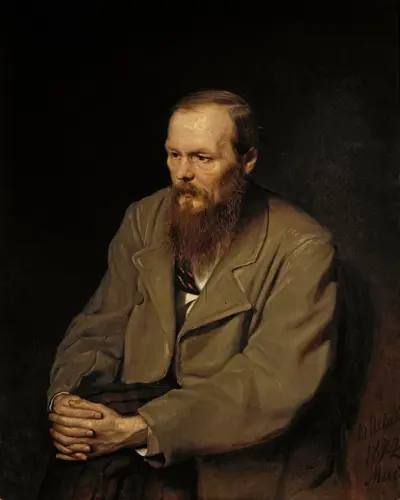
Fyodor Mikhailovich Dostoevsky, sometimes transliterated as Dostoyevsky, was a Russian novelist, philosopher, short story writer, essayist, and journalist. Dostoevsky's literary works explore human psychology in the troubled political, social, and spiritual atmospheres of 19th-century Russia, and engage with a variety of philosophical and religious themes. His most acclaimed works include Crime and Punishment (1866), The Idiot (1869), Demons (1872), and The Brothers Karamazov (1880). Dostoevsky's body of works consists of 12 novels, four novellas, 16 short stories, and numerous other works. Many literary critics rate him as one of the greatest psychological novelists in world literature. His 1864 novel Notes from Underground is considered to be one of the first works of existentialist literature.
