YUAN SHIKAI
Democracy and a republican form of government ran counter to the Chinese customs and failed, with Yuan Shikai taking all power—the “immemorial custom” of the autocratic Mancho and earlier Chinese dynasties. This failure of republican government in China so colored the future Chinese political leadership that both the Communists and Chang’s Kuomintang Nationalist anti-communists were both dictatorial and autocratic with great power lying in military hands. It was only in the later years of the 20th century that the Nationalists began to have a real democracy and although the Communists became avid capitalists and loosened up in terms of economic freedom, they did not feel the Chinese masses were ready to accept anything but the authoritarian political system that was the Chinese “immemorial custom”. They would not risk another collapse of modern government and all the factions fighting for control as in the Republic failure.
He had been a supporter of the monarchy and opposed the republic. However, he was so prestigious that the Republicans, after the revolution in 1911 selected him for the first President. However, he was a militarist conservative by nature and said that he wanted more power, and indeed, he took it. Soon he controlled the army and navy and then established himself as Emperor. The Chinese Republic was a mess.
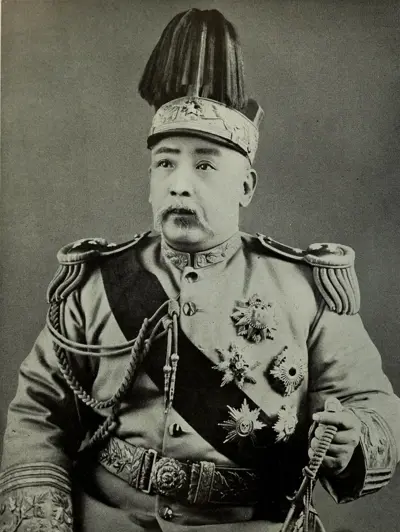
Yuan Shikai was a Chinese military and government official who rose to power during the late Qing dynasty, becoming the Emperor of the Empire of China (1915–1916). He tried to save the dynasty with a number of modernization projects including bureaucratic, fiscal, judicial, educational, and other reforms, despite playing a key part in the failure of the Hundred Days' Reform. He established the first modern army and a more efficient provincial government in North China in the last years of the Qing dynasty before the abdication of the Xuantong Emperor, the last monarch of the Qing dynasty, in 1912. Through negotiation, he became the first President of the Republic of China in 1912. This army and bureaucratic control were the foundation of his autocratic rule. He was frustrated in a short-lived attempt to restore hereditary monarchy in China, with himself as the Hongxian Emperor (Chinese: 洪憲皇帝). His death shortly after his abdication led to the fragmentation of the Chinese political system and the end of the Beiyang government as China's central authority.
