Euripides Quotes
Young man, two are the forces most precious to mankind. The first is Demeter, the Goddess. She is the Earth -- or any name you wish to call her -- and she sustains humanity with solid food. Next came Dionysus, the son of the virgin, bringing the counterpart to bread: wine and the blessings of life's flowing juices. His blood, the blood of the grape, lightens the burden of our mortal misery. Though himself a God, it is his blood we pour out to offer thanks to the Gods. And through him, we are blessed.
Euripides. Bacchae. Translated by David Grene and Richmond Lattimore, University of Chicago Press, 1959, lines 274-283.


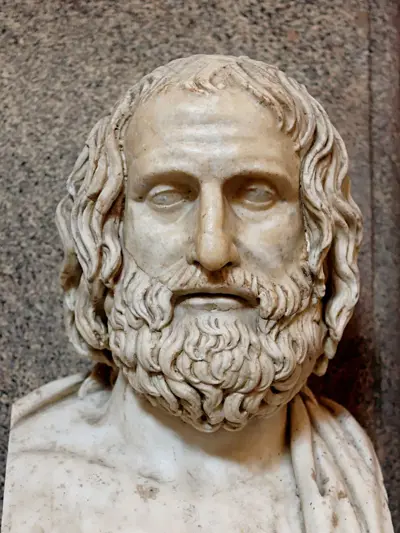
Euripides (/jʊəˈrɪpɪdiːz/; Greek: Εὐριπίδης Eurīpídēs, pronounced [eu̯.riː.pí.dɛːs]; c. 480 – c. 406 BC) was a tragedian of classical Athens. Along with Aeschylus and Sophocles, he is one of the three ancient Greek tragedians for whom any plays have survived in full. Some ancient scholars attributed ninety-five plays to him, but the Suda says it was ninety-two at most. Of these, eighteen or nineteen have survived more or less complete (Rhesus is suspect). There are many fragments (some substantial) of most of his other plays. More of his plays have survived intact than those of Aeschylus and Sophocles together, partly because his popularity grew as theirs declined—he became, in the Hellenistic Age, a cornerstone of ancient literary education, along with Homer, Demosthenes, and Menander.
