Aristophanes Quotes
You vote yourselves salaries out of the public funds and care only for your own personal interests; hence the state limps along.
Aristophanes. Ecclesiazusae. Translated by Eugene O'Neill Jr., Random House, 1938, p. 1016.


Before there was a separation of powers, the term “magistrate” referred to public officials who had the executive and judicial powers as well as some legislative authority. The term “Chief Magistrate” applied to the President of the United States is somewhat of a throwback to this older term and concept. In 17th century Ireland, magistrates were the chief authorities of each subarea, and corruption was rampant. To this day, the invitation to corruption and lack of long term interest in governance is given to support long terms of office and to oppose term limits.


Historically in America, the local governments have been the most corrupt. State government somewhat less so, and the Federal Government has statistically, given the number of employees, the lowest proportion of corrupt officials. Even in modern times, there are many local jurisdictions where bribes of building inspectors, zoning officials, health inspectors and police are still common. At the end of the 20th century, for example, every single Kentucky County Commissioners but one was indicted and convicted for accepting bribes and kickbacks. At the federal level, there is much moral corruption with Presidents and members of Congress taking "campaigh contributions" in exchange for access and the ability to influence and even write legislation. The members of Congress wrote the laws so activities that many peopke would see as corrupt was actually legal. Even when the campaign conributions were used to pay "salaries" to the relatives of the member of Congress or he/she added the money to his/her retirement fund.


She was the first Black woman to be elected to Congress and was the first Black woman to actively campaign for the Presidency
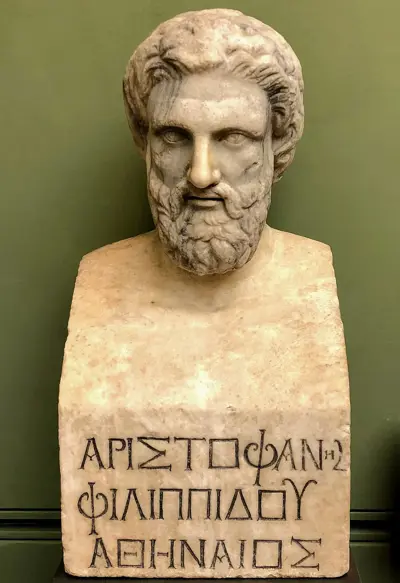
Aristophanes (/ˌærɪˈstɒfəniːz/; Ancient Greek: Ἀριστοφάνης, pronounced [aristopʰánɛːs]; c. 446 – c. 386 BC), son of Philippus, of the deme Kydathenaion (Latin: Cydathenaeum), was a comic playwright or comedy-writer of ancient Athens and a poet of Old Attic Comedy. Eleven of his forty plays survive virtually complete. These provide the most valuable examples of a genre of comic drama known as Old Comedy and are used to define it, along with fragments from dozens of lost plays by Aristophanes and his contemporaries.
