Persius Quotes
You follow words of the toga (language of the cultivated class).
[Lat., Verba togae sequeris.]
Persius. Juvenal and Persius. Translated by G. G. Ramsay, Loeb Classical Library 91, Harvard University Press, 1918, p. 373. (Satire 5, line 14).


Chivalry was a set of rules that regulated the behavior of knights especially as to their behavior in battle. It was the Medieval equivalent of the Geneva Convention. At the time knights fought against knights and peasants fought against peasants. After time the fighting was mixed. Previously, if a knight was subdued by other knights, he would surrender and promise to fight any more and that would be honored. But when a small group of peasants brought down a knight in armor, he could not surrender. He had probably killed other lightly armored peasants who were friends, and the peasants did not trust the knights. So typically, the peasants just killed the fallen knight. Social class determined the concepts of honor, fairness, trust, and chivalry came to an end.


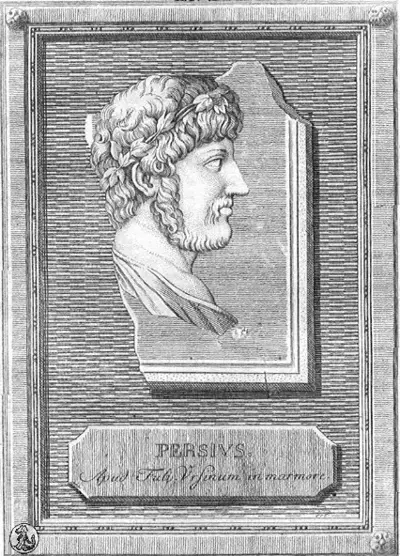
Aulus Persius Flaccus was a Roman poet and satirist of Etruscan origin. In his works, poems and satires, he shows a Stoic wisdom and a strong criticism for what he considered to be the stylistic abuses of his poetic contemporaries. His works, which became very popular in the Middle Ages, were published after his death by his friend and mentor, the Stoic philosopher Lucius Annaeus Cornutus.
