Jonathan Edwards Quotes
You all have by you a large treasure of divine knowledge, in that you have the Bible in your hands; therefore be not contented in possessing but little of this treasure.
Edwards, Jonathan. The Works of Jonathan Edwards. Vol. 2, Edward Hickman, 1834, p. 162.


This quotation illustrates that in the late 19th Century, there were still very prominent American scientists who were Biblical Literalists as well—a virtual intellectual impossibility. Dana was a Yale professor, and yet he rejected Evolution and had the age of the rocks he studied all wrong. At the time, America had only 1 great world class scientist (Physicist Albert A. Michelson) and American Science really became great in the 20th century. Dana was not a total incompetent however. He had amassed vast descriptive knowledge of California and other areas and was at the time considered America’s preeminent Geologist despite his lack of understanding of many fundamental aspects of his own science which was understood by many English and European scientists.

Although a conservative, he had a great tolerance for and understanding of other points of view. For this some people thought him a radical.

This view was infuriating to the Rabbis, Priests and Immams of the time. Miracles and Scrip[ture were not determinatve Spinoza taught but the issue was did the docrine of the religion make sense. Spinoza’s ideas were considered so radical and dangerous that he was the only man in history who was excommunicated by the Catholics, the Jews and the Muslims.

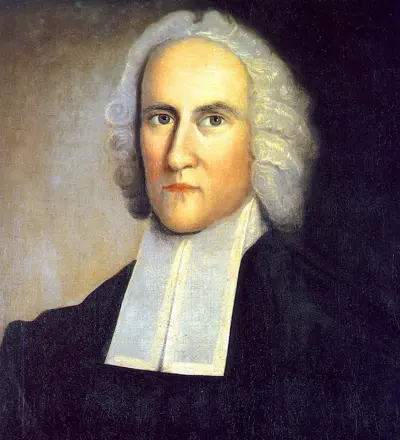
Jonathan Edwards was an American revivalist preacher, philosopher, and Congregationalist Protestant theologian. Edwards is widely regarded as one of America's most important and original philosophical theologians. Edwards' theological work is broad in scope, but rooted in the pedobaptist Puritan heritage as exemplified in the Westminster and Savoy Confessions of Faith. Recent studies have emphasized how thoroughly Edwards grounded his life's work on conceptions of beauty, harmony, and ethical fittingness, and how central The Enlightenment was to his mindset. Edwards played a critical role in shaping the First Great Awakening, and oversaw some of the first revivals in 1733–35 at his church in Northampton, Massachusetts. His theological work gave rise to a distinct school of theology known as the New England theology.
