Pindar Quotes
Words have a longer life than deeds.
Pindar. The Odes of Pindar. Translated by John Sandys, William Heinemann, 1915, p. 343.


Shammai’s school was a contemporary (and competitor) of that of Hillel. Most Rabbinic thought to this day has historically been based in the school of Hillel. Shammai was more strict and rigorous. There is no known surviving picture of Shammai. The graphic is a photograph of his tomb.


Jefferson was not anti-Christian as some accuse him. He was a great admirer of Jesus’ life and philosophy. He did object to the non-ethical aspects of Christianity, miracles, dogma, organized churches. See {611664}. Jefferson even went so far as to write his own version of the Bible—New Testament sometimes called the “Jefferson Bible”—where he translated the material and then extracted the ethical principles leaving out everything else.

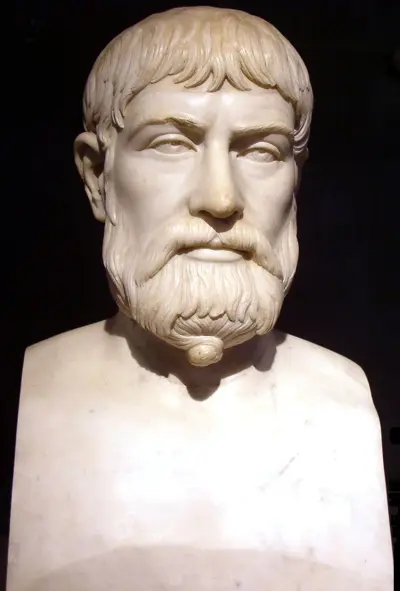
Pindar (/ˈpɪndər/; Greek: Πίνδαρος Pindaros, [píndaros]; Latin: Pindarus; c. 518 – 438 BC) was an Ancient Greek lyric poet from Thebes. Of the canonical nine lyric poets of ancient Greece, his work is the best preserved. Quintilian wrote, "Of the nine lyric poets, Pindar is by far the greatest, in virtue of his inspired magnificence, the beauty of his thoughts and figures, the rich exuberance of his language and matter, and his rolling flood of eloquence, characteristics which, as Horace rightly held, make him inimitable." His poems can also, however, seem difficult and even peculiar. The Athenian comic playwright Eupolis once remarked that they "are already reduced to silence by the disinclination of the multitude for elegant learning". Some scholars in the modern age also found his poetry perplexing, at least until the 1896 discovery of some poems by his rival Bacchylides; comparisons of their work showed that many of Pindar's idiosyncrasies are typical of archaic genres rather than of only the poet himself. His poetry, while admired by critics, still challenges the casual reader and his work is largely unread among the general public.
