Herman Melville Quotes
Will you, or will you not, quit me? I now demanded in a sudden passion, advancing close to him. "I would prefer not to quit you", he replied, gently emphasizing the not.
Melville, Herman. "Bartleby, the Scrivener: A Story of Wall-Street." Putnam's Monthly Magazine, vol. 2, no. 12, Dec. 1853, p. 614.


After being surrounded by the Germans for seven days at what would later be called the Battle of the Bulge, a German officer notified the Americans that they would accept their surrender. McAuliffe’s one word response summed up the resolve of the Americans who were surrounded. The Americans managed to hold the line and defeat the German’s last major offensive of World War II.


As Secretary of State, Powell was going to address the UN Security Council on the 5th and he was coordinating his speech with the other agencies of the government. His criterion was that he only wanted to make accusations that were backed up by incontrovertible evidence. However, VP Richard Cheney and his aide, Scooter Libby, kept inserting an accusation that Iraq was involved with and supported Al Qaeda. This was one of the many speculations that those who wanted to justify attacking Iraq kept using as Domestic propaganda. When Powell asked for proof or intelligence reports and none could be provided, he removed the accusation from the speech explaining why. However, at the last minute, Cheney and his staff put the accusation back in, and that triggered the quotation. Unfortunately, Powell was so busy fending off totally absurd accusations, that he accepted the CIA assurances {79468} that Iraq was developing nuclear weapons that were about to be operationalized and never heard from those who questioned the credibility of the sources for the basic accusation. Powell had great trust among the diplomats of the world then gave the United States version to the Security Council and justified our coming invasion of Iraq. But the intelligence report, despite the assurances of the CIA and the Vice President, was false and Iraq not only was not close to a nuclear weapon but he had no program at all at that time to try and develop one. Powell resigned and his credibility about the world was ruined as he was then seen as just another lying politician.

Barstow the Democratic Governor who had no serious opposition in 1853 found himself challenged for reelection by Coles Bashford of the new Republican Party. The Board of Canvassers reported that Governor Barstow had won reelection but by less than 200 votes in the whole state. The Republicans charged that there had been fraud in some of the rural districts and petitioned the Wisconsin Supreme Court which ruled that nonexistent precincts had indeed voted for the Governor. Barstow however refused to recognize the decisions of the court claiming that the court had no jurisdiction over the Board of Canvassers who were part of the executive branch. The Republicans held their own inauguration and two men claimed to be Governor. But the Governor claimed that the state constitution did not give the court any authority to deal with the crisis, He even called out the State Militia to maintain his office and intimidate the Supreme Court and keep the “other governor” from the state house. Nonetheless the court ruled that even the Governor had to obey the law and the Supreme Court would determine what the law was. Barstow finally “resigned.” See {587915} & {587917}.

She had asked Woodward when all the details about Richard Nixon and Watergate would finally be known. Woodward replied, “Never.”


Conant was also one of America’s premier scientists why had served on all the government policy committees about the atomic bomb development and use. He was the only scientist who had the respect of the greatest of the scientists and also was a respected government administrator with the confidence of the politicians. The “super” was the name then for the Hydrogen Bomb, a logical next step that could be taken according to the laws of physics. However J. Robert Oppenheimer and the Atomic Energy Commission General Advisory Committee he was chairing voted unanimously to NOT develop the Hydrogen Bomb at the time. The feeling was that if we did, the Russians would feel that they too would have to also, and their physicists were estimated to be easily capable of doing it. They thought that we could easily build more atom bombs—enough to wipe out Russian civilization if they attempted to use any of the atomic weapons they had built. The Chairman of the AEC and some other civilian officials who did not really understand the science but were they thought knowledgeable about international power politics, wanted to go ahead and build the “super” which Edward Teller had recommended and led the very few scientists on that side of the issue. The civilian hawks’ logic was that the Russians were so inferior to the United States that they could not have developed their atomic capability without having the information from their spies who had penetrated out program. If we built a supply of hydrogen weapons, they argued, the Russians could never gain parity if we maintained proper secrecy. They were not good enough scientists. Therefore we would dominate the world and could contain communism. Conant and most other American scientists knew that the Russians could develop supers and then we would be in a scientific arms race which in all probability we would not win every stage. Better they thought to have a stand off. However, the AEC Chairman started a campaign to destroy Oppenheimer’s credibility with the public as he was the public face of American Physics. The scientists lost the worst fight in American history between politicians and scientists. Conant, himself was appointed to literally be the peacetime ruler of West Germany and had a brilliant success there, but he was unable to stop the super development after Oppenheimer had been publicly castigated as a security leak. The Russians then developed their hydrogen weapons and the arms race continued throughout the Cold War as most of the scientists thought it would.


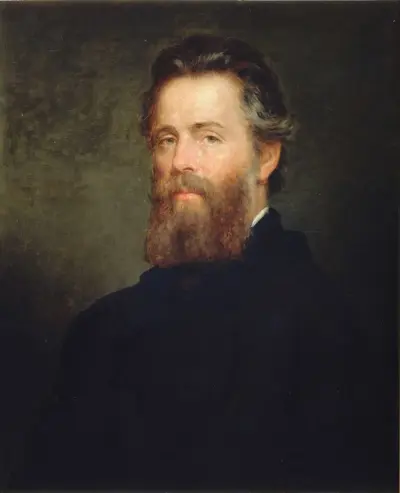
Herman Melville was an American novelist, short story writer, and poet of the American Renaissance period. Among his best-known works are Moby-Dick (1851), Typee (1846), a romanticized account of his experiences in Polynesia, and Billy Budd, Sailor, a posthumously published novella. Although his reputation was not high at the time of his death, the centennial of his birth in 1919 was the starting point of a Melville revival and Moby-Dick grew to be considered one of the great American novels.
