Rumi Quotes
Whoever brought me here will have to take me home.
Rumi, Jalal al-Din. The Essential Rumi. Translated by Coleman Barks, HarperSanFrancisco, 1995, p. 2.


French Foreign Minister Charles Gravier, Comte de Vergennes The diplomatic, financial and military assistance of France was critical to American survival at that time.


When the President met Nikita Khrushchev for talks, the Premier was wearing medals on his chest. Kennedy inquired what they were for, and the Premier explained that they were Lenin Peace Medals: See {610011} , {624747} , {45720} for more quotations regarding the summit meeting.

Many historians believe that Cheney really knew how to manipulate the President. In this case, he left the President with the feeling that if he did not strike at Saddam, he was somehow weak. Bush was a Texan who viewed many things in the perspective of the old West. Also Bush’s father had not “taken care” of Saddam earlier and the right wing war hawks portrayed him as “weak.” for not finishing Saddam off. See {621248}


President Theodore Roosevelt took and extended trip to the West and left William Howard Taft, then the Secretary of War, as the acting President and NOT the Secretary of State who many people erroneously think is the senior member of the cabinet, nor the Vice President. Roosevelt just put in charge the man he was most comfortable with. Interestingly, neither the Vice President or the Secretary of State objected or were disappointed. It was generally acknowledged that Taft was the best and strongest leader in the cabinet and that he was as close to the president as possible. See {639910}


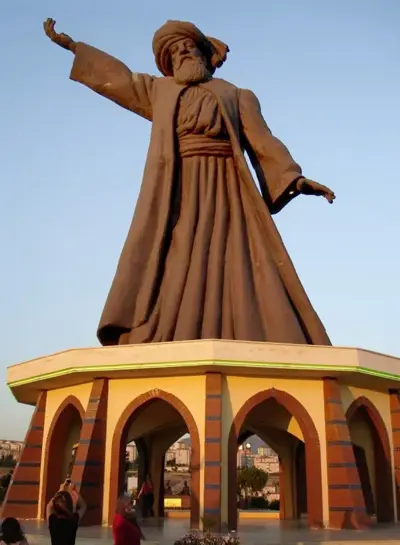
Jalāl ad-Dīn Mohammad Rūmī (Persian: جلالالدین محمد رومی), also known as Jalāl ad-Dīn Mohammad Balkhī (جلالالدین محمد بلخى), Mevlânâ/Mowlānā (مولانا, "our master"), Mevlevî/Mawlawī (مولوی, "my master"), and more popularly simply as Rumi, was a 13th-century Persian poet, Hanafi faqih, Islamic scholar, Maturidi theologian, and Sufi mystic originally from Greater Khorasan in Greater Iran. Rumi's influence transcends national borders and ethnic divisions: Iranians, Tajiks, Turks, Greeks, Pashtuns, other Central Asian Muslims, and the Muslims of the Indian subcontinent have greatly appreciated his spiritual legacy for the past seven centuries. His poems have been widely translated into many of the world's languages and transposed into various formats. Rumi has been described as the "most popular poet" and the "best selling poet" in the United States.
