Peter G. Peterson Quotes
While our superpower military is stunningly effective, it is also stunningly expensive.
Peter G. Peterson, U. S. Secretary of Commerce, Speech, Council on Foreign Relations, August 9, 2004
Sourced by: Eigen's Political and Historical Quotations


During the presidential debates George W. Bush stated that he would be very hesitant to use the military for nation building around the world. Less than a year later, the Bush administration, faced with the September 11, 2001 terrorist attacks, launched a massive attack on the Taliban regime in Afghanistan. After fighting and winning the war, the military soon realized that they would in fact be involved in nation building. However, with the assistance of the United Nations much of the humanitarian burden was lifted from the U.S. military.


Describing the nominee for Secretary of Defense, John Tower, who left the Senate to work as a highly paid consultant for defense contractors before being nominated as Secretary:


In early America, there was great concern about a standing army—a military force that exists and is organized in peacetime. History showed the founding fathers that tyrants who siezed power almost always did so by getting control of the standing army. The logic was if there is no standing army, no one can control it and therefore no tyrant can control the country by force. At the time, however, with oceans protecting us, there was penty of time to mobilize a defensive army should any foreign power invade. However, with modern military technology, and the importantance of retaliation as a protective3 strategy, it is virtually impossible to not have a standing army and stoll be secure.


He was referring to the famous Eisenhower quotation of 1961. See {641114}.


See {615006} for but one example of terrible military money and procurement management.

This was the origin of the term "military-industrial complex." This speech was written by Malcolm Moos who first penned the term. However, conceptually it was referred to earlier by C. Wright Mills in 1954— {623497}.


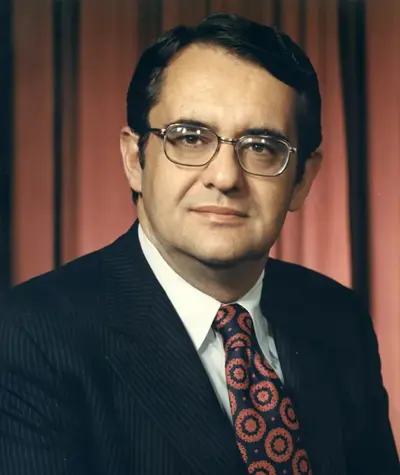
Peter George Peterson was an American investment banker who served as United States Secretary of Commerce from February 29, 1972, to February 1, 1973, under the Richard Nixon administration. Before serving as Secretary of Commerce, Peterson was also chairman and CEO of Bell & Howell from 1963 to 1971. From 1973 to 1984 he was chairman and CEO of Lehman Brothers. Later in 1985, he co-founded the private equity firm The Blackstone Group, and served as chairman. In the same year, Peterson became chairman of the Council on Foreign Relations, a position he held until his retirement in 2007 after which he was named chairman emeritus. In 2008, Peterson was ranked 149th on the "Forbes 400 Richest Americans" with a net worth of $2.8 billion. He was also known as founder and principal funder of The Peter G. Peterson Foundation, which is dedicated to promoting fiscal austerity.
