Kimberle Williams Crenshaw Quotes
While many Americans agree that 'the system is rigged' economically, few are aware of the ways in which racial inequality has been structured and embedded in our society. This is why candid, fact-based discussions about racial inequality are so desperately needed.


Gingrich prefaced his statement with: "It took me a long time and a number of people talking to me through the years to even get a sense of this..."


This quotation is a wonderful example of Donald Trump's hyperbolic oratory, Must politicians would say that "African communities are in terrible shape." But that would not get much media attention and coverage of his speech. So he ads ""worst". And not content with the dama of "worst" which was clearly untrue, he then added "Ever, Ever, Ever". Which not only makes the statement unture but rediculous in the light of lynchings, race riots, slavery, and other aspects of past African American experience in America. However, that evening, this line was on almost every news television show in America, repeated on radio, and was in the vast majority of newspapers. This lie got him millions of dollars in free publicity. No one had ever been better at manipulating the media that way. See Quotation 664146 for President Obama's comment on Trump's statement. Also, 644399 for the assessment of the NAACP President.


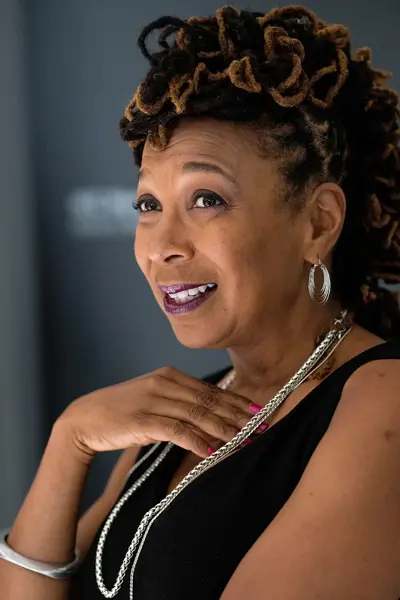
Kimberlé Williams Crenshaw (/ˈkɪmbərli/; born 1959) is an American lawyer, civil rights advocate, philosopher, and a leading scholar of critical race theory who developed the theory of intersectionality. She is a full-time professor at the UCLA School of Law and Columbia Law School, where she specializes in race and gender issues. Crenshaw is also the founder of Columbia Law School's Center for Intersectionality and Social Policy Studies (CISPS) and the African American Policy Forum (AAPF), as well as the president of the Berlin-based Center for Intersectional Justice (CIJ). Crenshaw is known for the introduction and development of intersectionality, the theory of how overlapping or intersecting social identities, particularly minority identities, relate to systems and structures of oppression, domination, or discrimination. Her scholarship was also essential in the development of intersectional feminism which examines the overlapping systems of oppression and discrimination to which women are subject due to their ethnicity, sexuality and economic background.
