John Ruskin Quotes
Which of us?is to do the hard and dirty work for the restand for what pay? Who is to do the pleasant and clean work, and for what pay?
Ruskin, John. Sesame and Lilies. Smith, Elder & Co., 1871, Preface, p. xxi.


In 1877 Wasburn was dropped from the List of Ministers by the Unitarian Church. He had become quite atheistic.

This is not a common quotation from Thoreau. The great man for whom the establishment had so much respect had a very anti-capitalist streak. His view is that the employer will generally never pay his laborers a fair wage. Instead he will pay the laborer the lowest rate for which he can obtain the laborers services. If the laborer generates added value for his wage, the employer is in a zero sum game with the laborer. If part of the added value—the profit is paid to the laborer, the employer does not have it for himself (or his stockholders). In most cases, the laborer is forced to work for his and his family’s subsistence. This theory argues that they only way the laborer will get a fair wage is if there is a labor shortage (assuming no government laws or union pressure is in the picture. Many capitalists argue that a “fair” wage is what a free man is willing to work for and a free employer is willing to pay. So economics is like politics in general with respect to fairness—there is no universally accepted definition of what is fair.

Even today, her simple bluntness about such a sensitive subject is jarring. Imagine how it appeared in 1867 when this was a foreign idea which when broached by a woman, or even a man, was phrased delicately and discreetly. And yet, her phraseology was virtually impossible to argue against.

One of the driving forces to employ the Negro was the lower wages that they could be paid compared to white workers.


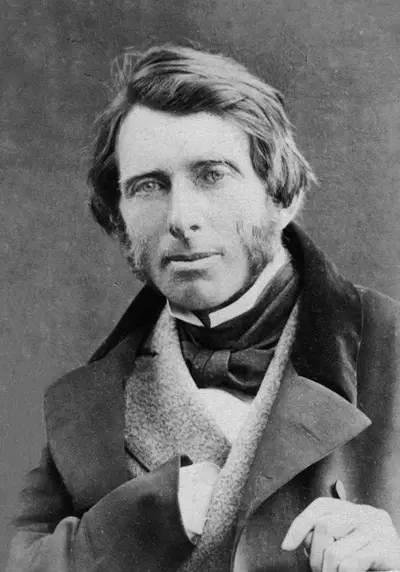
John Ruskin was the leading English art critic of the Victorian era, as well as an art patron, draughtsman, watercolourist, philosopher, prominent social thinker and philanthropist. He wrote on subjects as varied as geology, architecture, myth, ornithology, literature, education, botany and political economy.
