Vinod Khosla Quotes
When you make $78 billion a year, as the three large oil companies are doing, you have no interest in changing the status quo…. Oil companies are not interested innovation.
Vinod Khosla, Technology Venture Capitalist, PBS The Charlie Rose Show, September 22, 2006
Sourced by: Eigen's Political and Historical Quotations

There are those who worry that we will run out of oil. However, as Khosla observes, the more immediate danger is the pollution of the planet’s air supply by burning fossil fuels like oil in large volumes.

His assertion that wind energy is less expensive than the fossil fuel alternative is not accurate if one accounts for the costs on the basis of conventional accounting methods. It was at that time more expensive which is why it’s use was limited. However, the existing methods of accounting did not charge the fossil fuels for the environmental degregation that they cause and the cost to society to overcome these or live with them. More important there is no charge to the cost of fossil fuels for the deleterious health effects that their extraction and use cause. Global warming / climate change is not considered at all in the economic analysis.


Less than an average of 5 feet above sea level, Maldives is the lowest country in the world. It’s highest point is less than 8 feet high. The small increase in the world sea level resulting from climate change has already affected Maldives, and an increase of only a foot would wipe out a large part of the country.


Lott, like many other reasonably intelligent people who understood little about technology, did not realize that all the early efforts with a technology are relatively primitive and even the best ideas have to be engineered to scale and cost efficiency. A decade later, solar energy had become a significant industry in the work and the United States, which had invented many of the early technologies had lost the international lead in Solar Energy to Germany and China. The ultimate value of any technology cannot be judged by the initial technological efforts.


Both the Freon used in air conditioners and the energy to run the air conditioning equipment (generated by fossil fuels) contribute to global warming. Therefore Cox observes that the more air conditioning we use the warmer the climate as a whole gets. And then we need more air conditioning to be comfortable. This in turn produces more warming and Cox argues were are in an endless cycle. However, while this is true, the incremental energy required to produce the additional cooling to offset the global warming is relatively small. What is the greater problem is if the billions of people who do not now have air conditioning want it and get it. That will require enormous additional energy which could produce substantially more global warming. It should be noted that the United States has already banned Freon in favor of coolants which do not attack the ozone layer. And if the energy for air conditioning were produced by clean energy—nuclear, thermal, wind, hydroelectric or solar, the whole problem is moot and there would be no problem with air conditioning. However, as long as we use fossil fuels, Cox’s point is well taken.

Many argue that they are hardly reflected at all. The reason is the governments pay for much of the real cost and spread the cost over its taxpayers. Some costs are not monetary—premature deaths from pollution or corruption in petroeconomic corrupt states. People just suffer.
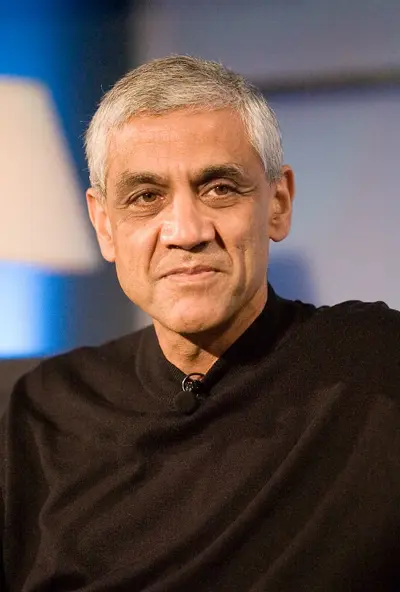
Vinod Khosla is an Indian-American billionaire businessman and venture capitalist. He is a co-founder of Sun Microsystems and the founder of Khosla Ventures. In 2014, Forbes counted him among the 400 richest people in the United States. In 2020, he was listed No. 353 on the Forbes 400 list.
