Ruth Bader Ginsburg Quotes
When police or prosecutors conceal significant exculpatory or impeaching material, we hold, it is ordinarily incumbent on the state to set the record straight.
Banks v. Dretke. 540 U.S. 668. Supreme Court of the United States, 24 Feb. 2004.


He was one of the few “national security hawks” who was willing to place this issue in the public table. In the 21st Century, there were some Muslims living in Democratic countries who were or had just become radical Islamic extremist jihadist by religious belief and philosophy. Some would preach or advocate violence in terrorism against Democracy and the west. Many of these people with radical Islamic beliefs would give material aid and comfort to terrorists and some would themselves engage in terrorist activities themselves. When they did, it was too late to prevent tragedies. So there was this population of emotional and intellectual terrorists who could act on their beliefs at any moment. These are what Hayden referred to as the “not yet guilty”. Preventive detention could protect against serious terrorist attacks. But the legal system of virtually every democracy had no legal bases to incarcerate or move against anyone for his/her beliefs or speech. Criminal charges required action other than thoughts, beliefs or speech. But by waiting until there is terrorist action, the law enforcement authorities give up the ability to prevent the terrorist action. Some were advocating changes in this fundamental and traditional distinction of law enforcement.


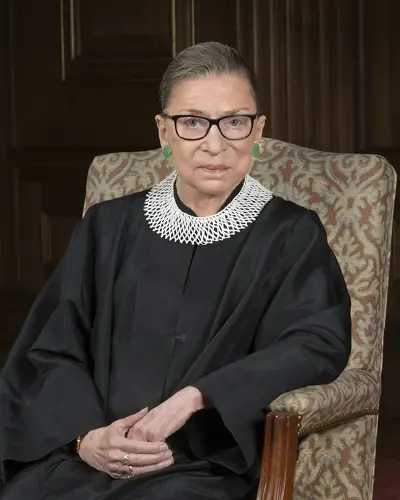
Joan Ruth Bader Ginsburg was an American lawyer and jurist who served as an associate justice of the Supreme Court of the United States from 1993 until her death in September 2020. She was nominated by President Bill Clinton, replacing retiring justice Byron White, and at the time was generally viewed as a moderate consensus-builder. She eventually became part of the liberal wing of the Court as the Court shifted to the right over time. Ginsburg was the first Jewish woman and the second woman to serve on the Court, after Sandra Day O'Connor. During her tenure, Ginsburg wrote notable majority opinions, including United States v. Virginia (1996), Olmstead v. L.C. (1999), Friends of the Earth, Inc. v. Laidlaw Environmental Services, Inc. (2000), and City of Sherrill v. Oneida Indian Nation of New York (2005).
