Jimmy Carter Quotes
When I was elected President nobody asked me to negotiate between Israel and Egypt. It was not even a question raised in my campaign. But I felt that one of the reasons that I was elected President was to try to bring peace to the Holy Land.
Carter, Jimmy. Keeping Faith: Memoirs of a President. Bantam Books, 1982.


The Palestinians were split between supporters of Hamas and Fatah. The former was a terrorist organization which refused to recognize the right of Israel to exist and whose charter called for the killing of all Jews. The latter, accepted the right of Israel to exist and was committed to peace and coexistence with the Jewish state. They had fought a civil war and Hamas controlled Gaza with well over 1 million people which they seized for force and killed of forced out Fatah Representatives. Fatah was the elected ruling party of the West Bank, the larger and more populous of the Palestinian territories. There was little chance of any peace given that split. However, Israel which had undergone over 7000 rockets fired upon them by Hamas, stated that they refused to negotiate with the Palestinians as long as the Hamas terrorists were a part of the control of the potential Palestinian state. They would only discuss a 2 state solution if Hamas agreed that they accepted the right of Israel to exist in their general territory as a Jewish State, Hamas would accept and follow previous agreements made with the Palestinians, and Hamas would give up terrorism and the objective of killing Jews. So either Hamas would have to change its policies or Israel would negotiate with an organization that claimed it would never accept the existence of that country as a Jewish state. Al-Masri thought that the agreement he had mediated, was a necessary first step and was constructive for all the parties.


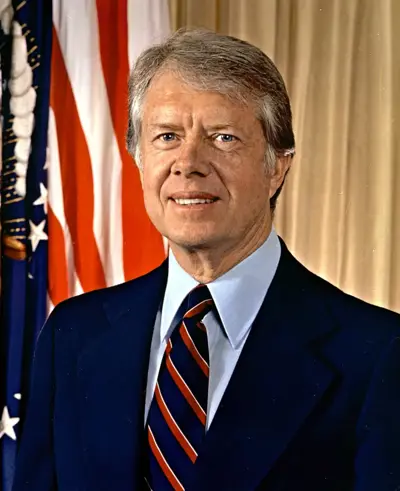
James Earl Carter Jr. is an American politician, businessman, and philanthropist who served as the 39th president of the United States from 1977 to 1981. A member of the Democratic Party, he previously served as a Georgia State Senator from 1963 to 1967 and as the 76th governor of Georgia from 1971 to 1975. Since leaving the presidency, Carter has remained engaged in political and social projects as a private citizen. In 2002, he was awarded the Nobel Peace Prize for his work in co-founding the Carter Center.
