Mikhail Khodorkovsky Quotes
What's important to me now is to uphold my good name and achieve a fair court decision - the past cannot be recovered anyway.


1st Earl of Beaconsfield


This quotation is sometimes misunderstood by Westerners as implying that abstract justice is not as important as practical achievements. However, to the Bedouin, as to most Arab cultures, abstract justice is extremely important—as is reputation. The Western translation might be: “Don’t confuse getting justice with achieving material gain. Often you may not gain anything material, but you still must maintain your honor or reputation. This notion, as many Arab ideas, starts out as applying to individuals, and then generalize to families, clans, tribes, nations, and even Islam as a whole.


An expose claimed that arch segregationist Senator Strom Thurmond had a sexual relationship with a Black woman and had a grown daughter as a result of that liaison. Congressman Wison, a redneck racist made this statement. Soon after, the daughter came out of the closet and the affair was out in the open. What is particularly interesting is that Wilson did not claim that the claim was a smear on the Senator’s morality, but he saw an accusation of fathering a mulatto child as a smear in INTEGRITY. This illustrates how pervasive the segregationist mentality extends to all facets of character.


This political issue has been in contention in every major world power since the Roman Empire. There has always been a division between hard liners and others. At issue is whether the nation should defend and or take up the cause of any national, individual, corporation, ideals even against a foreign country who may object to the behavior or use their own legal system to punish violators of their local laws. Failure to do so, they have argued over the years, makes the power appear weak and will invite further insult and transgressions. They claim that the government’s duty is always to protect its citizens from foreign elements regardless of whether the citizen’s behavior is right or wrong, reasonable or unreasonable, honest or dishonest. Also, this view holds that the nation should NEVER apologize as this makes it seem weak. These people have argued that it is the obverse of “My Country, Right or Wrong” and should be “Our Citizens, Right or Wrong”. On the other side, it is claimed that defending citizens or institutions that are clearly in the wrong not only is morally and ethically improper, but by being so indiscriminate, it weakens the nation’s power and credibility when it later wants to defend its citizens who are in the right and are being railroaded and discriminated against. And an apology, if the individual and institution has been in the wrong or caused harm and damage, is the proper thing to do and will often resolve matters and this is the best outcome often for the erring individual or institution. It is such a universal political issue of contention, that in the 2012 Presidential Campaign Mitt Romney had castigated President Barack Obama for apologizing to the African Nations for forcing their ancestors into American Slavery, even though Romney was very much opposed to slavery. It was the apology that makes America seem weak. The other side is that the apology shows that America has strong democratic principles and occasionally falls short, and when it does so, it acknowledges and corrects it setting a democratic example for all.
Watkins was the first Dallas County Black DA. He was being interviewed because DNA testing proved that a man who had served 30 years in prison for rape and robbery, could not have committed the crime, and he had just been released. Watkins quotation was very significant because it set forth a philosophy that while extant in other areas of the country is almost unheard of in Texas, where there have been more innocent men convicted than in any other state. DAs in Texas usually fight every attempt to examine old evidence with modern tools.


In one of the classic disputes between the military and civilian authorities, the government did not want to spend the money or risk the troops to expand French positions. The military officers however had a different view. Humbert suffered a military setback in the field and felt that he was caught in between the higher military and civilian authorities.
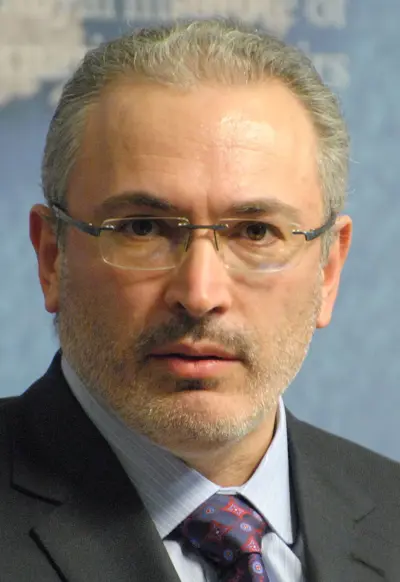
Mikhail Borisovich Khodorkovsky is an exiled Russian businessman, philanthropist and former oligarch, now residing in London. In 2003, Khodorkovsky was believed to be the wealthiest man in Russia, with a fortune estimated to be worth $15 billion, and was ranked 16th on Forbes list of billionaires. He had worked his way up the Komsomol apparatus, during the Soviet years, and started several businesses during the period of glasnost and perestroika in the late 1980s. After the dissolution of the Soviet Union, in the mid-1990s, he accumulated considerable wealth by obtaining control of a number of Siberian oil fields unified under the name Yukos, one of the major companies to emerge from the privatization of state assets during the 1990s (a scheme known as "Loans for Shares").
