Friedrich Nietzsche Quotes
Whatever a theologian regards as true must be false: there you have almost a criterion of truth.
Nietzsche, Friedrich. Twilight of the Idols and The Anti-Christ. Translated by R. J. Hollingdale, Penguin Books, 1990, p. 131.


Spinoza’s ideas were considered so radical and dangerous that he was the only man in history who was excommunicated by the Catholics, the Jews and the Muslims.


If someone repeats a lie, you can show them the logic and facts of the situation and persuade them often. But if they are ideologically wedded to an idea, it is difficult if not impossible to change their mind, as their belief is an ideology, not a conclusion.

The “experts” were scientists and science educators who had testified that Creationism, a notion that some religious Christians believe is a more valid explanation of the development of plants and animals than is Evolution, is a religious belief, not a science and should not be taught in a science curriculum. McLeroy believed that even in teaching science, scientific thinking and expertise should not be given more weight than religion in general and Christianity in particular. Some fundamentalist Protestants find Evolution distressing in that it contradicts the literal Biblical narrative. Other Protestants, Jews, and Catholics do not see anything in Evolution that conflicts with their spiritual view of God. They see Evolution as the mechanism that God created for the development of life. McLeroy was defeated in the next election after taking this anti scientific position, and was replaced with another fundamentalist Protestant—but one who did not believe that a particular Protestent, Christian view of the world which scientists generally reject should be taught as science in public schools.


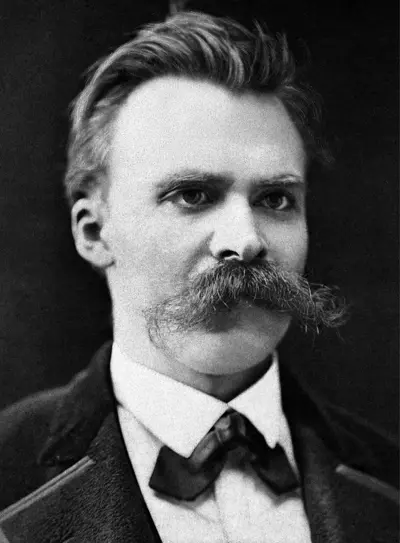
Friedrich Wilhelm Nietzsche was a German philosopher, cultural critic, composer, poet, writer, and philologist whose work has exerted a profound influence on modern intellectual history. He began his career as a classical philologist before turning to philosophy. He became the youngest person ever to hold the Chair of Classical Philology at the University of Basel in 1869 at the age of 24. Nietzsche resigned in 1879 due to health problems that plagued him most of his life; he completed much of his core writing in the following decade. In 1889, at age 44, he suffered a collapse and afterward a complete loss of his mental faculties. He lived his remaining years in the care of his mother until her death in 1897 and then with his sister Elisabeth Förster-Nietzsche. Nietzsche died in 1900.
