Thomas Aquinas Quotes
Whatever a man has in superabundance is owed, of natural right, to the poor for their sustenance. So Ambrosius says, and it is also to be found in the Decretum Gratiani: The bread which you withhold belongs to the hungry: the clothing you shut away, to the naked: and the money you bury in the earth is the redemption and freedom of the penniless.
Aquinas, Thomas. Summa Theologica. Translated by Fathers of the English Dominican Province, Benziger Bros., 1947, Part II-II, Question 66, Article 7.


If I had the power I would steal all your royal wealth and give it to Christ’s brothers and sisters.
Her monasteries were organized into male and female sections with monks and nuns respectively—a complete gender reversal of control of religious institutions of the Catholic Church where until modern times females were subservient to males. Remarkably, Brigid controlled both as there was no abbot. She heard confessions, ordained clergy, and may have even celebrated mass. Her first biographer claimed that she had been consecrated a bishop. Bishops were occasionally elected by the people. Brigid was one of the first political advocates of redistribution of wealth.


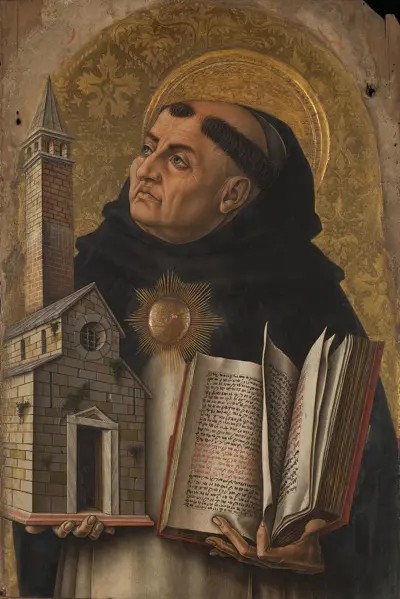
Thomas Aquinas was an Italian Dominican friar, philosopher, Catholic priest, and Doctor of the Church. An immensely influential philosopher, theologian, and jurist in the tradition of scholasticism, he is also known within the latter as the Doctor Angelicus, the Doctor Communis, and the Doctor Universalis. The name Aquinas identifies his ancestral origins in the county of Aquino in present-day Lazio, Italy. Among other things, he was a prominent proponent of natural theology and the father of a school of thought (encompassing both theology and philosophy) known as Thomism. He argued that God is the source of both the light of natural reason and the light of faith. His influence on Western thought is considerable, and much of modern philosophy developed or opposed his ideas, particularly in the areas of ethics, natural law, metaphysics, and political theory.
