Seneca the Younger Quotes
What must be shall be; and that which is a necessity to him that struggles, is little more than choice to him that is willing.
Seneca, Lucius Annaeus. Seneca's Morals by Way of Abstract. Translated by Roger L'Estrange, Harper & Brothers, 1839.


Charles was a young man who ruled under the thumb of his mother, Catherine de Medici. She and the leading Catholic political figures had decided to have the army massacre the Huguenots—Protestants—of France. Charles knew the massacre was to begin that night and tried to save his friend Rochefoucault, a Protestant, who was a member of the King’s court. He suggested several times that Rochefoucault not go home that evening but stay at the Louvre. The unsuspecting Rochefoucault felt that he had to get home to his wife and left explaining that to the King. Hence the King’s remark. Rochefoucault and his family were murdered that night. In the end, 50,000 Protestants were massacred in what has come to be known as the Massacre of Saint Bartholomew. Many of the palace servants were Protestants and were cut to ribbons throughout the palace. The King from a palace window shot a rifle at Protestants trying to swim the River Seine to escape, while his page kept reloading for him.


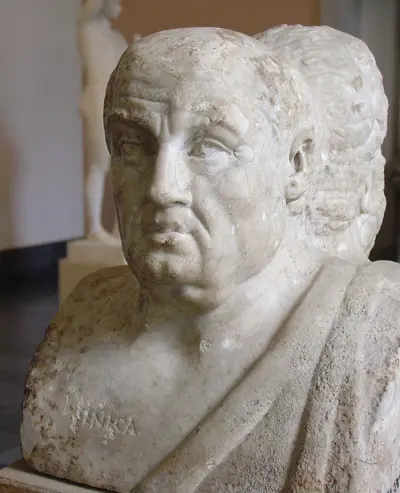
Lucius Annaeus Seneca the Younger (/ˈsɛnɪkə/; c. 4 BC – AD 65), usually known as Seneca, was a Roman Stoic philosopher, statesman, dramatist, and in one work, satirist from the Silver Age of Latin literature.
