Mahatma Gandhi Quotes
What is a man if he is not a thief who openly charges as much as he can for the goods he sells?
Gandhi, Mahatma. Young India. Navajivan Publishing House, 17 Nov. 1921, p. 367.


There were few if any consumer protection laws in those days and many wealthy aristocrats made their money by taking advantage of the poor. They were the landowners, bankers, financiers and often the industrialists. Shaw was a sarcastic social critic and this is a typical line he gave his upper class characters. Today, we have more controls on business and finance, and many wealthy business people have gotten that way by providing great value to the consumers and being honest. However, we still have large numbers of wealthy members of society who do make their money from the poor and middle class by unethical and often illegal means. In the aftermath of the Meltdown of 2008. hundreds of thousands of the homes of the working poor and middle class were foreclosed by the major banks forging the legal documentation for the foreclusures. Millions of consumer contracts are issued that even a PhD cannot understand the terms of without special legal and financial training. There is even a legal definition of a salesperson lying to make a sale which is so commonplace that our law excuses it and calls it "puffing". However, there has been over time, improvement over Shaw's era.

Ingersoll was considered to be the greatest orator and political thinker of his day, but his overt atheistic views curtailed his elected political career.


This Hadith together with the Prophet’s probation on interest appears to preclude a capitalistic economic structure. However, Muslim institutions have been very creative in interpreting these admonitions. Some Muslims give this a modern interpretation which prohibits price gouging but not fair profit. Regardless, it has always been interpreted to apply only to business transactions between Muslims. Profit can be made on trading and commerce with non-Muslims, and Muslim traders have always spanned the globe.


Samuel Langhorne Clemens, 1835-1910. The nature of telephone technology made it easy for companies to obtain monopolies for different areas of the country. When there is a monopoly, there is a huge tendency for the controlling company to charge very high prices and have poor customer service as the usual competition required for quality performance under capitalism is nonexistant. So in 1890, there was the same resentment of the telephone companies, that existed over a century later when there was still a monopoly. Regulation helped somewhat, but the capabilities of the monopolist began to include lobbying and campaign contributions so that typically, in the 21st century, the local telephone companies had much control over the State Commissions that were supposed to regulate them. Long distance service, whose monopoly was broken up by the Federal Courts became a wonderful service for customers and the prices were a tiny fraction of what they had been under their old monopoly.


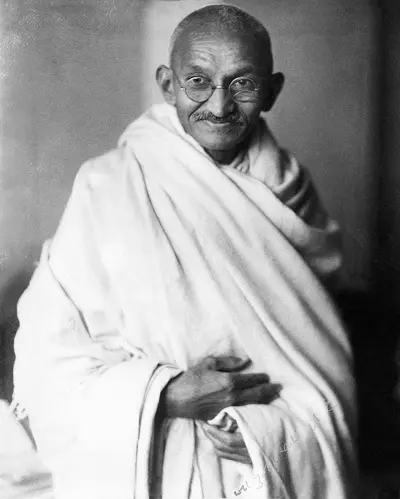
Mohandas Karamchand Gandhi was an Indian lawyer, anti-colonial nationalist, and political ethicist, who employed nonviolent resistance to lead the successful campaign for India's independence from British rule, and in turn inspired movements for civil rights and freedom across the world. The honorific Mahātmā (Sanskrit: "great-souled", "venerable"), first applied to him in 1914 in South Africa, is now used throughout the world.
